
|
You entered: cluster
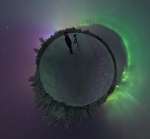 Planet Aurora Borealis
28.01.2012
Illuminated by an eerie greenish light, this remarkable little planet is covered with ice and snow and ringed by tall pine trees. Of course, this little planet is actually planet Earth, and the surrounding stars are above the horizon near Östersund, Sweden.
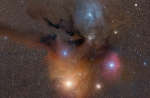 Colorful Clouds Near Rho Ophiuchi
28.08.2012
Why is the sky near Antares and Rho Ophiuchi so colorful? The colors result from a mixture of objects and processes. Fine dust illuminated from the front by starlight produces blue reflection nebulae. Gaseous clouds whose atoms are excited by ultraviolet starlight produce reddish emission nebulae. Backlit dust clouds block starlight and so appear dark.
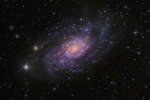 NGC 2403 in Camelopardalis
26.03.2015
Magnificent island universe NGC 2403 stands within the boundaries of the long-necked constellation Camelopardalis. Some 10 million light-years distant and about 50,000 light-years across, the spiral galaxy also seems to have more than its fair share of giant star forming HII regions, marked by the telltale reddish glow of atomic hydrogen gas.
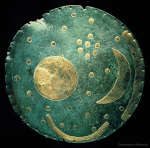 The Nebra Sky Disk
19.03.2018
It is considered the oldest known illustration of the night sky. But what, exactly, does it depict, and why was it made? The Nebra sky disk was found with a metal detector in 1999 by treasure hunters near Nebra, Germany, in the midst of several bronze-age weapons.
 Epsilon Tauri: Star with Planet
26.01.2024
Epsilon Tauri lies 146 light-years away. A K-type red giant star, epsilon Tau is cooler than the Sun, but with about 13 times the solar radius it has nearly 100 times the solar luminosity.
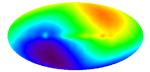 CMB Dipole: Speeding Through the Universe
28.01.2001
Our Earth is not at rest. The Earth moves around the Sun. The Sun orbits the center of the Milky Way Galaxy. The Milky Way Galaxy orbits in the Local Group of Galaxies. The Local Group falls toward the Virgo Cluster of Galaxies.
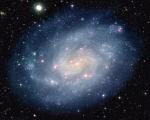 Spiral Galaxy NGC 300
21.08.2002
NGC 300 is so interesting because it is so normal. An Sc-type spiral galaxy in the nearby Sculptor group of galaxies, NGC 300 shows typical flowing blue spiral arms, an expected compact nucleus, and the requisite amount of stars, star clusters, and nebulae.
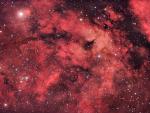 A Cygnus Star Field
28.07.2004
In the constellation of the swan near the nebula of the pelican lies the gas cloud of the butterfly surrounding a star known as the hen. That star, given the proper name Sadr, is visible to the unaided eye but found here as the brightest object on the upper left.
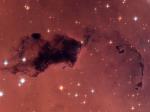 A Dust Cloud in NGC 281
20.04.2006
Stars themselves can create huge and intricate dust sculptures from the dense and dark molecular clouds from which they are born. The tools the stars use to carve their detailed works are high energy light and fast stellar winds.
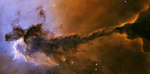 The Fairy of Eagle Nebula
9.12.2007
The dust sculptures of the Eagle Nebula are evaporating. As powerful starlight whittles away these cool cosmic mountains, the statuesque pillars that remain might be imagined as mythical beasts. Pictured above is one of several striking dust pillars of the Eagle Nebula that might be described as a gigantic alien fairy.
|
January February March April May June July August September October |
|||||||||||||||||||||||||||||||||||||||||||||||||