
|
You entered: Titan
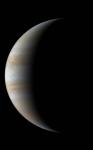 Farewell Jupiter
9.03.2003
Next stop: Saturn. The Cassini spacecraft, launched from Earth in 1997, has now swung past Jupiter and should arrive at Saturn in the year 2004. Pictured to the left is a parting shot from Cassini in January that would not have been possible from Earth: Jupiter showing a crescent phase.
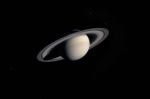 Cassini Approaches Saturn
10.12.2003
Cassini, a robot spacecraft launched in 1997 by NASA, is close enough now to resolve many rings and moons of its destination planet: Saturn. The spacecraft has now closed to within a single Earth-Sun separation from the ringed giant. Early last month, Cassini snapped the contrast-enhanced color composite pictured above.
 Mars Saturn Conjunction
9.04.2022
Fainter stars in the zodiacal constellation Capricornus are scattered near the plane of the ecliptic in this field of view. The two brightest ones at center aren't stars at all though, but the planets Mars and Saturn.
 A Great White Spot on Rhea
30.05.2005
Why caused this great white spot on the surface of Saturn's moon Rhea? The spot was first noticed last year by the robot Cassini spacecraft now orbiting Saturn. Cassini's flyby of Rhea in April imaged in the spot in great detail.
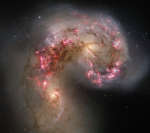 The Antennae Galaxies in Collision
18.07.2010
Two galaxies are squaring off in Corvus and here are the latest pictures. But when two galaxies collide, the stars that compose them usually do not. That's because galaxies are mostly empty space and, however bright, stars only take up only a small amount of that space.
 APOD: 2025 August 23 Б Fishing for the Moon
23.08.2025
How big is planet Earth's Moon? Compared to other moons of the Solar System, it's number 5 on the largest to smallest ranked list, following Jupiter's moon Ganymede, Saturn's moon Titan, and Jovian moons Callisto and Io. Continuing the list, the Moon comes before Jupiter's Europa and Neptune's Triton.
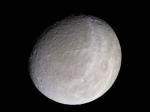 Saturns Moon Rhea from Cassini
15.02.2005
Each moon of Saturn seems to come with its own mystery. Rhea, Saturn's second largest moon behind Titan, shows unusual wisps, visible above as light colored streaks. Higher resolution images of the wisps show them to be made of long braided fractures.
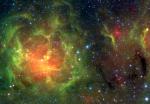 Infrared Trifid
13.01.2005
The Trifid Nebula, aka M20, is easy to find with a small telescope, a well known stop in the nebula rich constellation Sagittarius. But where visible light pictures show the nebula divided into three parts by dark, obscuring dust lanes, this penetrating infrared image reveals filaments of luminous gas and newborn stars.
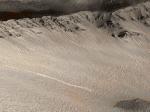 A Year of Extraterrestrial Fountains and Flows
31.12.2006
The past year was extraordinary for the discovery of extraterrestrial fountains and flows -- some offering new potential in the search for liquid water and the origin of life beyond planet Earth.. Increased evidence was uncovered that fountains spurt not only from Saturn's moon Enceladus, but from the dunes of Mars as well.
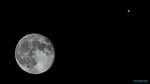 Moons and Jupiter
3.03.2016
Some of the Solar System's largest moons rose together on February 23. On that night, a twilight pairing of a waning gibbous Moon and Jupiter was captured in this sharp telescopic field of view.
|
January February March April May June July August September October |
|||||||||||||||||||||||||||||||||||||||||||||||||