
|
You entered: Titan
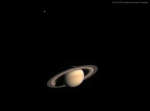 Cassini Approaches Saturn
10.04.2016
Cassini, a robot spacecraft launched in 1997 by NASA, became close enough in 2002 to resolve many rings and moons of its destination planet: Saturn. At that time, Cassini snapped several images during an engineering test. Several of those images were combined into the contrast-enhanced color composite featured here.
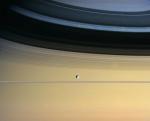 A Year at Saturn
31.12.2005
Arriving at Saturn in July of 2004, the Cassini spacecraft has now spent a year and a half exploring the magnificent rings and moons of the distant gas giant. The year 2005 began with Cassini's Huygens probe landing on Saturn's large moon Titan.
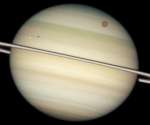 Saturn: Moons in Transit
19.03.2009
Every 14 to 15 years, Saturn's rings are tilted edge-on to our line of sight. As the bright, beautiful rings seem to grow narrower it becomes increasingly difficult to see them, even with large telescopes. But it does provide the opportunity to watch multiple transits of Saturn's moons.
 Saturn and Six Moons
6.07.2021
How many moons does Saturn have? So far 82 have been confirmed, the smallest being only a fraction of a kilometer across. Six of its largest satellites can be seen here in a composite...
 Pleiades from Planet Earth
1.11.2025
The lovely Pleiades star cluster shines in Earth's night sky, a compact group of stars some 400 light-years distant toward the constellation Taurus and the Orion Arm of our Milky Way galaxy. Recognized since ancient times, the remarkable celestial gathering is visible to the unaided eye.
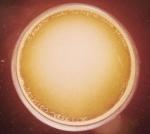 Huygens Discovers Luna Saturni
25.03.2005
In 1655, three hundred fifty years ago on this date, Dutch astronomer Christiaan Huygens discovered Luna Saturni - now known as Saturn's moon Titan. To celebrate, consider this intriguing picture of his telescope lens, all that remains of the instrument he used, designed and constructed in collaboration with his brother, Constantijn Huygens.
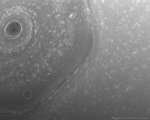 Over Saturns Turbulent North Pole
12.12.2016
The Cassini spacecraft's Grand Finale at Saturn has begun. The Grand Finale will allow Cassini to explore Saturn and some of Saturn's moons and rings in unprecedented detail. The first phase started...
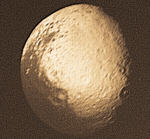 Iapetus: Saturn's Disappearing Moon
15.10.1995
Iapetus has an unusual surface, one half of which is very dark, the other half very light. This caused it's discoverer Cassini to remark that Iapetus could only be seen when on one side of Saturn but not the other. The reason for the difference between hemispheres is presently unknown.
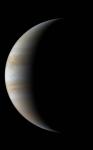 Farewell Jupiter
8.08.2001
Next stop: Saturn. The Cassini spacecraft, launched from Earth four years ago, has now swung past Jupiter and should arrive at Saturn in the year 2004. Pictured to the left is a parting shot from Cassini in January that would not have been possible from Earth: Jupiter showing a crescent phase.
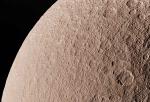 Rhea: Saturns Second Largest Moon
5.12.1999
Rhea is the second largest moon of Saturn, behind Titan, and the largest without an atmosphere. It is composed mostly of water ice, but has a small rocky core. Rhea's rotation and orbit are locked together (just like Earth's Moon) so that one side always faces Saturn.
|
January February March April May June July August September October |
|||||||||||||||||||||||||||||||||||||||||||||||||