
|
You entered: century
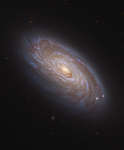 Messier 88
28.12.2022
Charles Messier described the 88th entry in his 18th century catalog of Nebulae and Star Clusters as a spiral nebula without stars. Of course the gorgeous M88 is now understood to be a galaxy full of stars, gas, and dust, not unlike our own Milky Way.
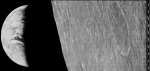 Restored: First Image of the Earth from the Moon
18.11.2008
Pictured above is the first image ever taken of the Earth from the Moon. The image was taken in 1966 by Lunar Orbiter 1 and heralded by then-journalists as the Image of the Century. It was taken about two years before the Apollo 8 crew snapped its more famous color cousin.
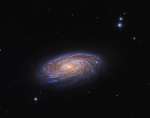 Messier 88
30.01.2010
Charles Messier described the 88th entry in his 18th century catalog of Nebulae and Star Clusters as a spiral nebula without stars. Of course the gorgeous M88 is now understood to be a galaxy full of stars, gas, and dust, not unlike our own Milky Way.
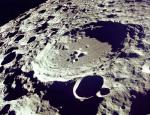 Lunar Farside from Apollo 11
12.03.2003
The far side of the Moon is rough and filled with craters. By comparison, the near side of the Moon, the side we always see, is relatively smooth. Since the Moon is rotation locked to always point the same side toward Earth, humanity has only glimpsed the lunar farside recently -- last century.
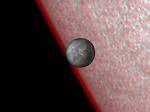 3D Mercury Transit
25.11.2006
Mercury is now visible shortly before dawn, the brightest "star" just above the eastern horizon. But almost two weeks ago Mercury actually crossed the face of the Sun for the second time in the 21st century.
 Anticrepuscular Rays at the Planet Festival
19.07.2024
For some, these subtle bands of light and shadow stretched across the sky as the Sun set on July 11. Known as anticrepuscular rays, the bands are formed as a large cloud bank near the western horizon cast long shadows through the atmosphere at sunset.
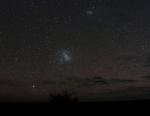 Magellanic Morning
9.08.2006
This early morning skyscape recorded near Winton, Queensland, Australia, looks toward the southeast. Low clouds are seen in silhouette against the first hints of sunlight, while two famous cosmic clouds, the Clouds of Magellan, also hover in the brightening sky.
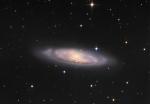 Messier 65
1.06.2007
M65 is a big, beautiful spiral galaxy, the sixty-fifth object in the famous astronomical catalog compiled by 18th century cosmic tourist Charles Messier. It's also a member of a picturesque trio of large spiral galaxies known as the Leo Triplet, about 35 million light-years away.
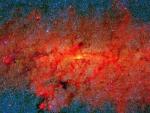 The Galactic Center Across the Infrared
7.07.2002
The center of our Galaxy is obscured in visible light by dark dust that rotates with the stars in the Galactic Plane. In this century, however, sensors have been developed that can detect light more red that humans can see - light called infrared.
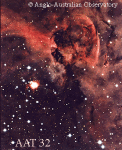 The Keyhole Nebula Near Eta Carinae
4.04.1996
The dark dusty Keyhole Nebula gets its name from its unusual shape. Designated NGC 3324, the Keyhole Nebula is a smaller region superposed on the bright Eta Carina Nebula. The Eta Carina Nebula...
|
January February March April May June July August September |
|||||||||||||||||||||||||||||||||||||||||||||||||