
|
You entered: century
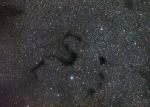 Snake in the Dark
21.05.2005
Dark nebulae snake across a gorgeous expanse of stars in this wide-field view toward the pronounceable constellation Ophiucus and the center of our Milky Way Galaxy. In fact, the central S-shape seen here is well known as the Snake Nebula.
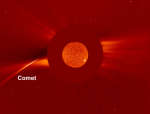 New Year Sun Grazer
16.01.2010
Intense and overwhelming, the direct glare of the Sun is blocked by the smooth occulting disk in this image from the sun-staring SOHO spacecraft. Taken on January 3rd, an extreme ultraviolet image of the Sun to scale, is superimposed at the center of the disk.
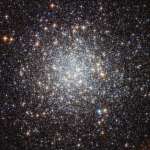 Messier 9 Close Up
23.03.2012
Renown 18th century astronomer Charles Messier described this 9th entry in his famous astronomical catalog as "Nebula, without star, in the right leg of Ophiuchus ...". But Messier 9 (M9) does have stars, known to modern astronomers as a globular cluster of over 300,000 stars within a diameter of about 90 light-years.
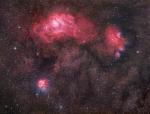 Sagittarius Triplet
9.09.2004
These three bright nebulae are often featured in telescopic tours of the constellation Sagittarius and the view toward the center of our Milky Way galaxy. In fact, 18th century cosmic tourist Charles Messier cataloged two of them; M8, the nebula above and left of center, and colorful M20 at the lower left.
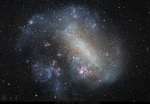 The Large Cloud of Magellan
27.08.2015
The 16th century Portuguese navigator Ferdinand Magellan and his crew had plenty of time to study the southern sky during the first circumnavigation of planet Earth. As a result, two fuzzy cloud-like objects easily...
 Messier 2
19.12.2024
After the Crab Nebula, this giant star cluster is the second entry in 18th century astronomer Charles Messier's famous list of things that are not comets. M2 is one of the largest globular star clusters now known to roam the halo of our Milky Way galaxy.
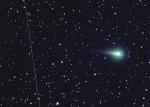 Announcing Comet C 2002 T7 LINEAR
9.02.2004
A newly discovered comet may outshine most stars in the sky by May. Designated Comet C/2002 T7 (LINEAR), the comet was discovered in 2002 October by project LINEAR. Many reports already place the comet as brighter than magnitude 7, meaning that it can now be seen with binoculars.
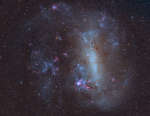 The Large Cloud of Magellan
5.09.2019
The 16th century Portuguese navigator Ferdinand Magellan and his crew had plenty of time to study the southern sky during the first circumnavigation of planet Earth. As a result, two fuzzy cloud-like objects easily...
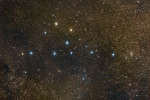 Collinder 399: The Coat Hanger
23.12.2008
Is this coat hanger a star cluster or an asterism? This cosmic hang-up has been debated over much of last century, as astronomers wondered whether this binocular-visible object is really a physically associated open cluster or a chance projection. Chance star projections are known as asterisms, an example of which is the popular Big Dipper.
 Venus and Jupiter are Far
3.07.2015
On June 30 Venus and Jupiter were actually far apart, but both appeared close in western skies at dusk. Near the culmination of this year's gorgeous conjunction, the two bright evening planets...
|
January February March April May June July August September |
|||||||||||||||||||||||||||||||||||||||||||||||||