
|
You entered: century
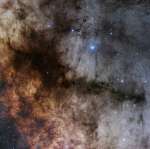 The Pipe Nebula
23.11.2012
East of Antares, dark markings sprawl through crowded star fields toward the center of our Milky Way Galaxy. Cataloged in the early 20th century by astronomer E. E. Barnard, the obscuring interstellar dust clouds include B59, B72, B77 and B78, seen in silhouette against the starry background.
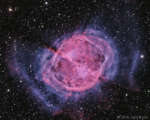 M27: The Dumbbell Nebula
2.11.2016
The first hint of what will become of our Sun was discovered inadvertently in 1764. At that time, Charles Messier was compiling a list of diffuse objects not to be confused with comets.
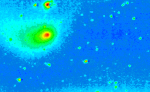 Comet Hale-Bopp Outbound
10.09.1997
Hale-Bopp, the Comet of the Century, is leaving the inner Solar System. Outbound at about 12 miles per second it is presently nearing the main asteroid belt between Mars and Jupiter. This false-color image represents a recent view from low Earth orbit showing the comet surrounded by its shrinking coma against a background of stars.
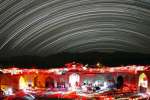 Running Messier s Marathon
19.04.2008
Gripped by an astronomical spring fever, many northern hemisphere stargazers embark on a Messier Marathon. Completing the marathon requires viewing all 110 objects in 18th century French astronomer Charles Messier's catalog in one glorious dusk-to-dawn observing run.
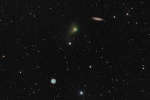 The Comet, the Owl, and the Galaxy
21.04.2016
Comet C/2014 S2 (PanSTARRS) poses for a Messier moment in this telescopic snapshot from April 18. In fact it shares the 1.5 degree wide field-of-view with two well-known entries in the 18th century comet-hunting astronomer's famous catalog.
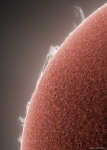 Active Prominences on a Quiet Sun
20.08.2018
Why is the Sun so quiet? As the Sun enters into a period of time known as a Solar Minimum, it is, as expected, showing fewer sunspots and active regions than usual. The quietness is somewhat unsettling, though, as so far this year, most days show no sunspots at all.
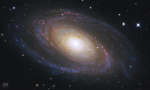 Messier 81
27.03.2025
One of the brightest galaxies in planet Earth's sky is similar in size to our Milky Way Galaxy: big, beautiful Messier 81. Also known as NGC 3031 or Bode's galaxy for its 18th century discoverer, this grand spiral can be found toward the northern constellation of Ursa Major, the Great Bear.
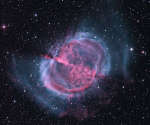 M27: The Dumbbell Nebula
14.09.2014
The first hint of what will become of our Sun was discovered inadvertently in 1764. At that time, Charles Messier was compiling a list of diffuse objects not to be confused with comets.
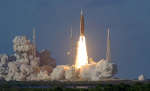 Liftoff! Returning to the Moon
2.04.2026
We are one small step closer to returning to the Moon. A new chapter in human exploration began yesterday when NASA's Artemis II launched aboard the Space Launch System (SLS) from Kennedy Space Center. Carrying four astronauts, the Orion spacecraft's planned lunar flyby will be the first in over half a century.
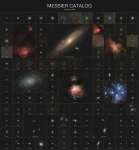 APOD: 2026 May 14 Б The Messier Catalog at Uniform Scale
14.05.2026
What are some of the most interesting astronomical objects you can see in the night sky? Armed with a good pair of binoculars or a small telescope, if you live in the Northern Hemisphere, you can look for the very popular objects in the Messier Catalog.
|
January February March April May June July August September |
|||||||||||||||||||||||||||||||||||||||||||||||||