
|
You entered: century
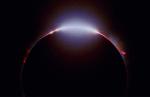 Madagascar Totality
26.07.2001
When the Moon's shadow reached out and touched Earth's southern hemisphere on 2001 June 21, the first total solar eclipse of the 21st century began. Starting in the Atlantic, the dark, central...
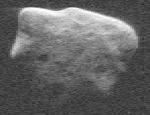 1999 JM8: A Rock Too Close
1.09.1999
Nearly four kilometers across, the huge rock known as 1999 JM8 silently passed only 8.5 million kilometers from the Earth in early August. The small asteroid was completely unknown before May. Every few centuries, a rock like this impacts the Earth, with the potential to disrupt modern civilization.
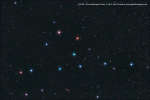 Collinder 399: The Coat Hanger
26.08.2015
Is this coat hanger a star cluster or an asterism? This cosmic hang-up has been debated over much of last century, as astronomers wondered whether this binocular-visible object is really a physically associated open cluster or a chance projection. Chance star projections are known as asterisms, an example of which is the popular Big Dipper.
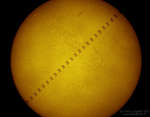 ISS and Mercury Too
13.05.2016
Transits of Mercury are relatively rare. Monday's leisurely 7.5 hour long event was only the 2nd of 14 Mercury transits in the 21st century. If you're willing to travel, transits of the International Space Station can be more frequent though, and much quicker.
 Facing NGC 6946
26.07.2024
From our vantage point in the Milky Way Galaxy, we see NGC 6946 face-on. The big, beautiful spiral galaxy is located just 20 million light-years away, behind a veil of foreground dust and stars in the high and far-off constellation Cepheus.
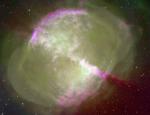 M27: The Dumbbell Nebula
6.03.2001
The first hint of what will become of our Sun was discovered inadvertently in 1764. At that time, Charles Messier was compiling a list of "annoying" diffuse objects not to be confused with "interesting" comets.
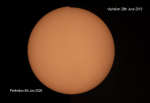 Perihelion to Aphelion
9.01.2020
Perihelion for 2020, the point in Earth's elliptical orbit when it is closest to the Sun, occurred on January 5th. The distance from the Sun doesn't determine the seasons, though. Those...
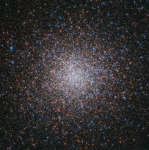 APOD: 2026 May 23 Б Messier 2
23.05.2026
After the Crab Nebula, this giant star cluster is the second entry in 18th century astronomer Charles Messier's famous list of things that are not comets. M2 is one of the largest globular star clusters now known to roam the halo of our Milky Way galaxy.
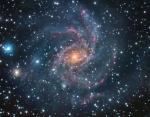 Facing NGC 6946
10.04.2004
From our vantage point in the Milky Way Galaxy, we see NGC 6946 face-on. The big beautiful spiral galaxy is located just 10 million light-years away, behind a veil of foreground stars in the high and far-off constellation of Cepheus.
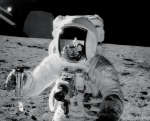 Apollo 12: Self Portrait
24.11.2019
Is this image art? 50 years ago, Apollo 12 astronaut-photographer Charles "Pete" Conrad recorded this masterpiece while documenting colleague Alan Bean's lunar soil collection activities on Oceanus Procellarum. The featured image is dramatic and stark.
|
January February March April May June July August September |
|||||||||||||||||||||||||||||||||||||||||||||||||