
|
You entered: dwarf galaxy
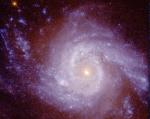 Spiral Galaxy NGC 3310 in Ultraviolet
17.01.2001
Why is NGC 3310 bursting with young stars? The brightest of these new stars are so hot that they light up this spiral galaxy not only in blue light, but in light so blue humans can't see it: ultraviolet. The Hubble Space Telescope took the above photograph in different bands of ultraviolet light.
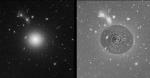 The Secret Spiral Of IC3328
2.06.2000
IC3328 is an otherwise unremarkable dwarf elliptical galaxy about 50 million light-years away in the Virgo cluster. But hidden within IC3328 is a subtle, beautifully symmetric spiral structure! A team of astronomers recently made this totally surprising discovery using detailed digital images from the European Southern Observatory's 8.2 meter Antu telescope.
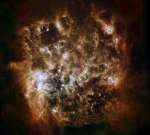 Infrared Portrait of the Large Magellanic Cloud
15.01.2012
Cosmic dust clouds ripple across this infrared portrait of our Milky Way's satellite galaxy, the Large Magellanic Cloud. In fact, the remarkable composite image from the Herschel Space Observatory and the Spitzer Space Telescope show that dust clouds fill this neighboring dwarf galaxy, much like dust along the plane of the Milky Way itself.
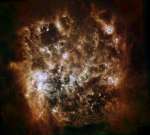 Infrared Portrait of the Large Magellanic Cloud
23.03.2013
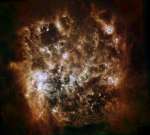
Cosmic dust clouds ripple across this infrared portrait of our Milky Way's satellite galaxy, the Large Magellanic Cloud. In fact, the remarkable composite image from the Herschel Space Observatory and the Spitzer Space Telescope show that dust clouds fill this neighboring dwarf galaxy, much like dust along the plane of the Milky Way itself.
 Infrared Portrait of the Large Magellanic Cloud
14.01.2016
Cosmic dust clouds ripple across this infrared portrait of our Milky Way's satellite galaxy, the Large Magellanic Cloud. In fact, the remarkable composite image from the Herschel Space Observatory and the Spitzer Space Telescope show that dust clouds fill this neighboring dwarf galaxy, much like dust along the plane of the Milky Way itself.
 The View Toward M101
4.05.2018
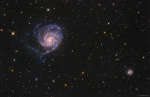
Big, beautiful spiral galaxy M101 is one of the last entries in Charles Messier's famous catalog, but definitely not one of the least. About 170,000 light-years across, this galaxy is enormous, almost twice the size of our own Milky Way galaxy.
 The Large Cloud Of Magellan (LMC)
24.01.1998
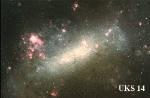
Ferdinand Magellan and his crew had plenty of time to study the southern sky during their famous voyage around the world. As a result, two fuzzy cloud-like objects, not visible to northern hemisphere dwellers, are now known as the Clouds of Magellan.
 ASCA X-Ray Observatory
20.02.1996
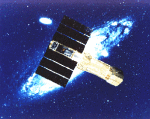
Today marks the third anniversary of the launch of the Advanced Satellite for Cosmology and Astrophysics (ASCA; renamed from Astro D when launched). ASCA, seen here superposed on galaxy M31, is a Japanese satellite for which NASA has provided some scientific equipment. ASCA carries four large-area X-ray telescopes.
 Local Group Galaxy NGC 6822
23.01.2002
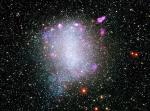
Nearby galaxy NGC 6822 is irregular in several ways. First, the galaxy's star distribution merits a formal classification of dwarf irregular, and from our vantage-point the small galaxy appears nearly rectangular. What strikes...
 ISON, Mars, Regulus
17.10.2013
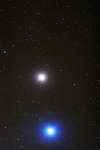
In order top to bottom this celestial snapshot features Comet ISON, planet Mars, and Regulus, alpha star of the constellation Leo, in the same frame. The scene spans about 2 degrees near the eastern horizon in early morning skies of October 15.
|
January February March April May June July August |
||||||||||||||||||||||||||||||||||||||||||||||||||||||||