
|
You entered: helium
 SIRTF Streak
5.09.2003
Streaking skyward, a Boeing Delta 2-Heavy rocket carries NASA's Space InfraRed Telescope Facility (SIRTF) aloft during the early morning hours of August 25th. The dramatic scene was recorded in a time exposure from...
 Balloon TIGER
1.02.2002
Where does a two-ton tiger hang out? Well, in this case the Trans-Iron Galactic Element Recorder (TIGER) experiment hangs from a mobile crane on the far left in this panorama photo recorded last December near McMurdo Station, Antarctica.
 La Superba
18.12.2008
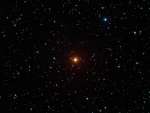
Y Canum Venaticorum (Y CVn) is a very rare star in planet Earth's night sky. It's also very red, exhibiting such a remarkable spectrum of light, 19th century astronomer Angelo Secchi dubbed it La Superba.
 APOD: 2026 May 21 Б A Collision of Galaxy Clusters
21.05.2026
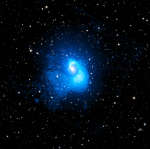
This big beautiful spiral shines in X-ray light. It is about 20 times larger than our Galaxy. It belongs to Abell 2029, a galaxy cluster one billion light-years away. (To see only the galaxies...
 Elements in the Aftermath
1.08.2019
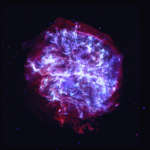
Massive stars spend their brief lives furiously burning nuclear fuel. Through fusion at extreme temperatures and densities surrounding the stellar core, nuclei of light elements ike Hydrogen and Helium are combined to heavier elements like Carbon, Oxygen, etc. in a progression which ends with Iron.
 A Jupiter Vista from Juno
23.11.2020
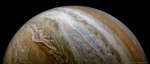
Why do colorful cloud bands encircle Jupiter? Jupiter's top atmospheric layer is divided into light zones and dark belts that go all the way around the giant planet. It is high horizontal winds -- in excess of 300 kilometers per hour -- that cause the zones to spread out planet-wide.
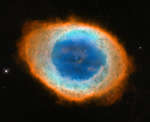 M57: The Ring Nebula
5.06.2013
Except for the rings of Saturn, the Ring Nebula (M57) is probably the most famous celestial band. Its classic appearance is understood to be due to our own perspective, though. The recent mapping...
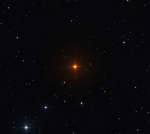 R Leporis: A Vampire's Star
31.10.2018
Better known as Hind's Crimson Star, R Leporis is a rare star in planet Earth's night sky. It's also a shocking shade of red. The star's discoverer, 19th century English...
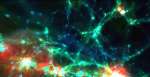 Illustris Simulation of the Universe
23.02.2020
How did we get here? Click play, sit back, and watch. A computer simulation of the evolution of the universe provides insight into how galaxies formed and perspectives into humanity's place in the universe.
 APOD: 2023 December 31 Б Illustris: A Simulation of the Universe
31.12.2023
How did we get here? Click play, sit back, and watch. A computer simulation of the evolution of the universe provides insight into how galaxies formed and perspectives into humanity's place in the universe.
|
January February March April May June July August September October |
|||||||||||||||||||||||||||||||||||||||||||||||||