
|
You entered: helium
 Two Hours Before Neptune
14.02.2015
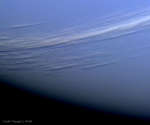
Two hours before closest approach to Neptune in 1989, the Voyager 2 robot spacecraft snapped this picture. Clearly visible for the first time were long light-colored cirrus-type clouds floating high in Neptune's atmosphere. Shadows of these clouds can even be seen on lower cloud decks.
 Blue Sun Bristling
4.11.2009
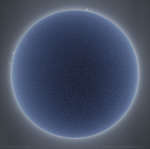
Our Sun may look like all soft and fluffy, but it's not. Our Sun is an extremely large ball of bubbling hot gas, mostly hydrogen gas. The above picture...
 The Flash Spectrum of the Sun
15.11.2013
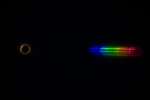
In a flash, the visible spectrum of the Sun changed from absorption to emission on November 3rd, during the brief total phase of a solar eclipse. That fleeting moment is captured by telephoto lens and diffraction grating in this well-timed image from clearing skies over Gabon in equatorial Africa.
 The Great Nebula in Orion
3.07.1995
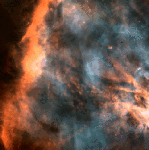
The Great Nebula in Orion, M42, can be found on the night sky just below and to the left of the easily identifiable belt of three stars in the popular constellation Orion. This nebula is one of the closest stellar nurseries - where young stars are being formed even now.
 Dark Spots on Neptune
21.08.2001
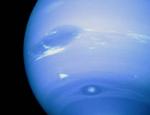
Neptune has spots. The Solar System's outermost gas giant shows a nearly uniform blue hue created by small amounts of methane drifting in a thick atmosphere of nearly colorless hydrogen and helium. Dark spots do appear, however, that are anti-cyclones: large high-pressure systems that swirl in Neptune's cold cloud tops.
 The Milky Way's Center
8.09.1995
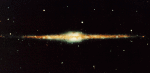
NASA's COBE satellite scanned the heavens at infrared wavelengths in 1990 and produced this premier view of the central region of our own Milky Way Galaxy. The Milky Way is a typical spiral galaxy with a central bulge and extended disk of stars.
 The Solar Spectrum
15.08.2000
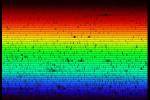
It is still not known why the Sun's light is missing some colors. Shown above are all the visible colors of the Sun, produced by passing the Sun's light through a prism-like device.
 Echoes from the Depths of a Red Giant Star
8.04.2011
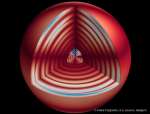
A journey to the center of a red giant star is very firmly in the realm of science fiction. But the science of asteroseismology can explore the conditions there. The technique is to time the small variations in a star's brightness measured by the planet hunting Kepler spacecraft.
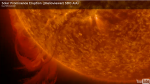 A Huge Solar Filament Erupts
15.12.2010
Click the arrow and watch an unusually long filament explode out from the Sun. The filament had been seen hovering over the Sun's surface for over a week before it erupted earlier this month.
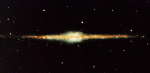 The Milky Way's Center
15.03.1997
Although the Earth is round, our Galaxy appears truly flat. This was shown in dramatic fashion by the COsmic Background Explorer (COBE) satellite which produced this premier view of the central region of our own Milky Way Galaxy in infrared light in1990.
|
January February March April May June July August September October |
|||||||||||||||||||||||||||||||||||||||||||||||||