
|
You entered: sky
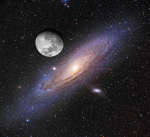 Moon over Andromeda
25.09.2020
The Great Spiral Galaxy in Andromeda (also known as M31), a mere 2.5 million light-years distant, is the closest large spiral to our own Milky Way. Andromeda is visible to the unaided...
 APOD: 2025 November 2 Б A Horseshoe Einstein Ring from Hubble
2.11.2025
What's large and blue and can wrap itself around an entire galaxy? A gravitational lens mirage. Pictured here, the gravity of a massive elliptical galaxy (luminous red galaxy: LRG) has gravitationally distorted the light from a much more distant blue galaxy.
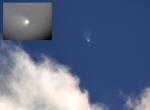 McNaught s Matinee
19.01.2007
Comets grow bright when they're close to the Sun, basking in the intense solar radiation. Of course, they're also usually impossible to see against the overwhelming scattered sunlight. But surprising Comet McNaught...
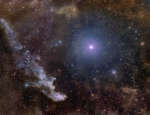 Rigel and the Witch Head Nebula
29.12.2009
Double, double toil and trouble; Fire burn, and cauldron bubble -- maybe Macbeth should have consulted the Witch Head Nebula. This suggestively shaped reflection nebula on the lower left is associated with the bright star Rigel, to its right, in the constellation Orion.
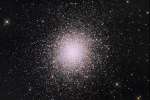 M13: The Great Globular Cluster in Hercules
27.05.2010
In 1716, English astronomer Edmond Halley noted, "This is but a little Patch, but it shews it self to the naked Eye, when the Sky is serene and the Moon absent." Of course...
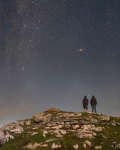 The Galaxy Between Two Friends
6.11.2021
On an August night two friends enjoyed this view after a day's hike on the Plateau d'Emparis in the French Alps. At 2400 meters altitude the sky was clear. Light from a setting moon illuminates the foreground captured in the simple vertical panorama of images.
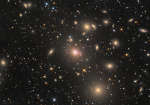 NGC 1275 in the Perseus Cluster
5.02.2026
Active galaxy NGC 1275 is the central, dominant member of the large and relatively nearby Perseus Cluster of Galaxies. Wild-looking at visible wavelengths, the active galaxy is also a prodigious source of x-rays and radio emission.
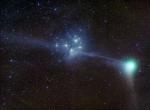 Machholz Meets the Pleiades
11.01.2005
Sweeping northward in planet Earth's sky, comet Machholz extended its long ion tail with the Pleiades star cluster in the background on January 7th. This stunning view, recorded with a telephoto lens in skies over Oberjoch, Bavaria, Germany, emphasizes faint, complex tail structures and the scene's lovely blue and green colors.
 A Total Solar Eclipse Over China
5.08.2008
What's that black dot over the Sun? The Moon. This past weekend, the Sun went dark during the day as the Moon completely covered it. The total solar eclipse was visible over a thin swath of Earth extending from northern Canada to China.
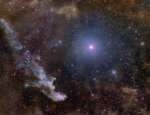 Rigel and the Witch Head Nebula
1.11.2012
Double, double toil and trouble; Fire burn, and cauldron bubble -- maybe Macbeth should have consulted the Witch Head Nebula. The suggestively shaped reflection nebula is associated with the bright star Rigel in the constellation Orion.
|
January February March April May June July August September October |
|||||||||||||||||||||||||||||||||||||||||||||||||