
|
You entered: sky
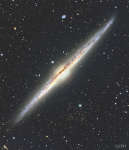 NGC 4565: Galaxy on Edge
16.05.2021
Is our Milky Way Galaxy this thin? Magnificent spiral galaxy NGC 4565 is viewed edge-on from planet Earth. Also known as the Needle Galaxy for its narrow profile, bright NGC 4565 is a stop on many telescopic tours of the northern sky, in the faint but well-groomed constellation Coma Berenices.
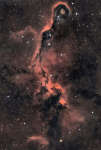 APOD: 2026 August 20 Б The Elephant s Trunk in Cepheus
19.08.2026
Like an illustration in a galactic Just So Story, the Elephant's Trunk Nebula winds through the emission region and young star cluster complex IC 1396, in the high and far off constellation of Cepheus. Also known as vdB 142, this cosmic elephant's trunk is over 20 light-years long.
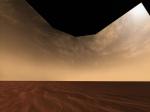 Clouds and Sand on the Horizon of Mars
17.10.2006
If you could stand on Mars -- what might you see? Like the robotic Opportunity rover rolling across the red planet, you might well see vast plains of red sand, an orange tinted sky, and wispy light clouds.
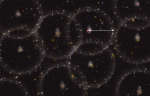 Baryon Acoustic Oscillations from SDSS III
20.01.2014
How large do things appear when far away? When peering across the universe, the answer can actually tell us about its average gravitational history and hence its composition. Toward this goal, the Baryon Oscillation...
 Aurora Dog over Alaska
29.04.2014
Sometimes it is hard to believe what you see in the sky. While leading his annual aurora tour last month near Fairbanks in central Alaska, astrophotographer John Chumack and his company saw a most unusual aurora. This bright aurora appeared to change into the shape of a jumping dog, complete with a curly tail.
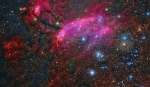 IC 4628: The Prawn Nebula
8.12.2016
South of Antares, in the tail of the nebula-rich constellation Scorpius, lies emission nebula IC 4628. Nearby hot, massive stars, millions of years young, irradiate the nebula with invisible ultraviolet light, stripping electrons from atoms. The electrons eventually recombine with the atoms to produce the visible nebular glow, dominated by the red emission of hydrogen.
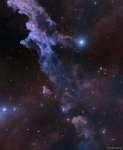 The Witch Head Nebula
30.12.2018
Double, double toil and trouble; Fire burn, and cauldron bubble .... maybe Macbeth should have consulted the Witch Head Nebula. A frighteningly shaped reflection nebula, this cosmic crone is about 800 light-years away though. Its malevolent visage seems to glare toward nearby bright star Rigel in Orion, just off the right edge of this frame.
 APOD: 2025 February 9 Б Milky Way over the Australian Pinnacles
8.02.2025
What strange world is this? Earth. In the foreground of the featured image are the Pinnacles, unusual rock spires in Nambung National Park in Western Australia. Made of ancient sea shells (limestone), how these human-sized picturesque spires formed remains unknown.
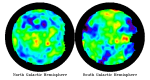 COBE Hotspots:The Oldest Structures Known
8.03.1997
Above are two images of the microwave sky, north and south of our galaxy's equator, based on data from NASA's COsmic Background Explorer (COBE) satellite. After computer processing to remove contributions from nearby objects and the effects of the earth's motion, they show "spots".
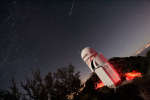 Geminids over Kit Peak
15.12.2010
Two large telescope domes stand in the foreground of this night sky view from Kitt Peak National Observatory, near Tucson, Arizona, USA. The dramatic scene was recorded early Tuesday morning, near the peak of December's Geminid Meteor Shower.
|
January February March April May June July August September October |
|||||||||||||||||||||||||||||||||||||||||||||||||