
|
You entered: rings
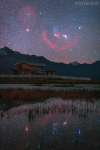 Orion Over and Under Tibet
4.10.2015
This night was so serene you could see Orion rise downwards. The unusual spectacle was captured in this single-exposure image, featuring a deep sky around the famous constellation of Orion that appeared both above -- and reflected in -- a peaceful lake in the Gyirong Valley of Tibet, China.
 Sunrise from the Surface of Gliese 581c
2.05.2007
How might a sunrise appear on Gliese 581c? One artistic guess is shown above. Gliese 581c is the most Earth-like planet yet discovered and lies a mere 20 light-years distant. The central red dwarf...
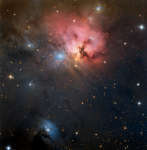 NGC 1579: Trifid of the North
9.03.2012
Colorful NGC 1579 resembles the better known Trifid Nebula, but lies much farther north in planet Earth's sky, in the heroic constellation Perseus. About 2,100 light-years away and 3 light-years across...
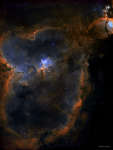 Bright from the Heart Nebula
26.10.2015
What's that inside the Heart Nebula? First, the large emission nebula dubbed IC 1805 looks, in whole, like a human heart. The nebula glows brightly in red light emitted by its most prominent element: hydrogen.
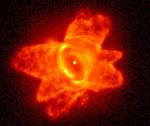 PKS285 02: A Young Planetary Nebula
22.06.1999
How do planetary nebulae acquire their exquisite geometrical shapes? To investigate this, astronomers used the Hubble Space Telescope to image several young planetary nebulae. These nebulae are the outer envelopes of stars like our Sun that have recently been cast away to space, leaving behind a core fading to become a white dwarf.
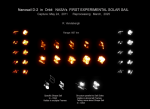 NanoSail D2
1.01.2026
In 2011, on January 20, NASA's NanoSail-D2 unfurled a very thin and very reflective 10 square meter sail becoming the first solar sail spacecraft in low Earth orbit. Often considered the stuff...
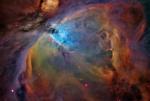 An Orion of a Different Color
24.03.2004
Look up into the sky tonight, and even with a good telescope you won't come across a sight quite like this one. It is a familiar object though, the grand stellar nursery known as the Orion Nebula.
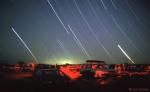 Star Party Trails
21.05.1999
Stargazing is fun! If you'd like to try it, this weekend may be your chance as many astronomy clubs and organizations will be hosting public celebrations of Astronomy Day on Saturday, May 22nd. In recent years, open house nights at observatories, astronomy club gatherings, and star parties have become increasingly popular.
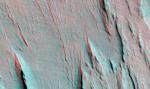 The Yardangs Of Mars
13.11.2000
OK, fans of classic science fiction might be disappointed. The yardangs are not barsoomian warriors in a newly discovered Edgar Rice Burroughs tale of adventure and conquest on the Red Planet. In fact yardangs, geologists' term for narrow, wind-eroded ridges, are common land features in the desert regions of planet Earth.
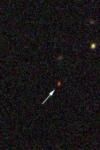 High Redshift Quasars
10.12.1998
Each red speck indicated above is a powerful quasar estimated to be over 100 times brighter than a galaxy. Yet in these Sloan Digital Sky Survey discovery images the quasars appear faint because they are extremely distant.
|
January February March April May June July August September October |
|||||||||||||||||||||||||||||||||||||||||||||||||