
|
You entered: rings
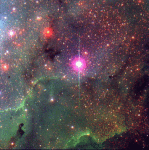 Starbirth in the Lagoon Nebula
24.10.1996
Stars are forming even today in the Lagoon Nebula. This bright nebula is visible in the constellation of Sagittarius with binoculars. The above photo is the result of a new sensitive camera being attached to one of the world's largest telescopes.
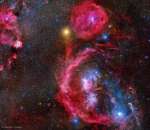 A 212 Hour Exposure of Orion
29.03.2020
The constellation of Orion is much more than three stars in a row. It is a direction in space that is rich with impressive nebulas. To better appreciate this well-known swath of sky, an extremely long exposure was taken over many clear nights in 2013 and 2014.
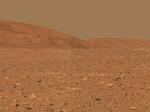 Spirit Rover Reaches the Columbia Hills on Mars
28.06.2004
The Spirit robotic rover on Mars has now reached the Columbia Hills on Mars. Two of the hills are shown on approach near the beginning of June. The above true-color picture shows very nearly what a human would see from Spirit's vantage point.
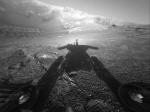 Shadow of a Martian Robot
4.02.2007
What if you saw your shadow on Mars and it wasn't human? Then you might be the Opportunity rover currently exploring Mars. Opportunity and sister robot Spirit have been probing the red planet since early 2004, finding evidence of ancient water, and sending breathtaking images across the inner Solar System.
 APOD: 2025 October 21 Б IC 1805: The Heart Nebula
21.10.2025
What electrifies the Heart Nebula? First, the large emission nebula on the left, catalogued as IC 1805, looks somewhat like a human heart. The nebula glows brightly in red light emitted by its most prominent element, hydrogen, but this long-exposure image was also blended with light emitted by sulfur (yellow) and oxygen (blue).
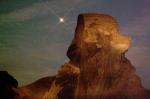 Mars Rising Behind Poodle Rock
13.08.2003
Have you seen Mars lately? As Earth and Mars near their closest approach in nearly 60,000 years on August 27, the red planet has begun to appear dramatically bright and show interesting details through telescopes and binoculars. Although not yet visible at sunset, Mars can be seen rising increasingly earlier in the evening.
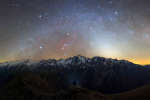 Zodiacal Night
10.04.2021
An intense band of zodiacal light is captured in this serene mountain and night skyscape from April 7. The panoramic view was recorded after three hours of hiking from a vantage looking west after sunset across the Pyrenees in southern France. At 2838 meters altitude, Mont Valier is the tallest peak near center.
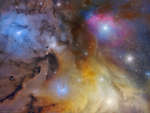 Stars, Dust, and Gas Near Antares
26.01.2022
Why is the sky near Antares and Rho Ophiuchi so dusty yet colorful? The colors result from a mixture of objects and processes. Fine dust -- illuminated from the front by starlight -- produces blue reflection nebulae. Gaseous clouds whose atoms are excited by ultraviolet starlight produce reddish emission nebulae.
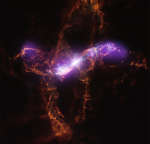 Symbiotic R Aquarii
5.02.2022
Variable star R Aquarii is actually an interacting binary star system, two stars that seem to have a close symbiotic relationship. Centered in this space-based optical/x-ray composite image it lies about 710 light years away.
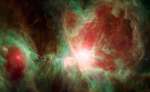 Spitzer s Orion
17.09.2011
Few cosmic vistas excite the imagination like the Orion Nebula, an immense stellar nursery some 1,500 light-years away. This stunning false-color view spans about 40 light-years across the region, constructed using infrared data from the Spitzer Space Telescope.
|
January February March April May June July August September October |
|||||||||||||||||||||||||||||||||||||||||||||||||