
|
You entered: rings
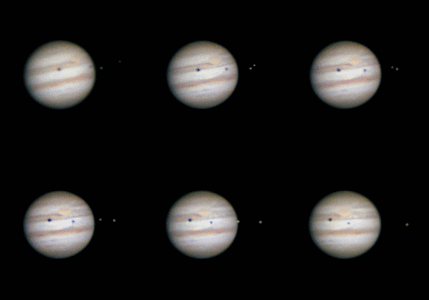 When Moons and Shadows Dance
27.02.2003
It's no wonder Jupiter is a favorite target for even modest earthbound telescopes. The most massive planet in the solar system with four of the largest moons also boasts the famous Great Red Spot, a giant hurricane-like storm system over three hundred years old.
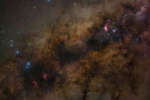 Sagittarius and the Central Milky Way
19.05.2009
What does the center of our Milky Way Galaxy look like? In visible light, no one knows! It is not possible to see the Galactic center in light our eyes are sensitive to because the thick dust in the plane of our Galaxy obscures it.
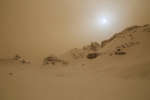 Swiss Alps, Martian Sky
18.02.2021
Taken on February 6, this snowy mountain and skyscape was captured near Melchsee-Frutt, central Switzerland, planet Earth. The reddish daylight and blue tinted glow around the afternoon Sun are colors of the Martian sky, though. Of course both worlds have the same Sun.
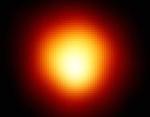 Betelgeuse, Betelgeuse, Betelgeuse
5.06.1999
Betelgeuse (sounds a lot like "beetle juice"), a red supergiant star about 600 light years distant, is seen in this Hubble Space Telescope image - the first direct picture of the surface of a star other than the Sun. While Betelgeuse is cooler than the Sun, it is more massive and over 1000 times larger.
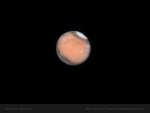 Mars Opposition 2010
29.01.2010
Mars is at opposition tonight, opposite the Sun in planet Earth's sky. Of course, it will be easy to spot because Mars appears close to tonight's Full Moon, also opposite the Sun in Earth's night sky in the constellation Cancer.
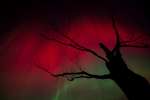 October Skylights
28.10.2011
As northern hemisphere nights grow longer, October is a good month for spotting auroras, or even other eerie apparitions after dark. And this week the night sky did not disappoint. On October 24th a solar coronal mass ejection impacted planet Earth's magnetosphere triggering far ranging auroral displays.
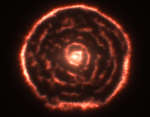 A Spiral Nebula Surrounding Star R Sculptoris
16.10.2012
What's happening around that star? An unusual spiral structure has been discovered around the Milky Way star R Sculptoris, a red giant star located about 1,500 light years away toward the constellation of the Sculptor (Sculptoris).
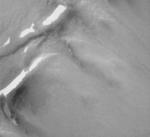 Ski Mars
1.04.1999
These brightly reflecting fields of snow or frost are on the slopes of a crater rim in the northern hemisphere of Mars. They are 500 meters or so long and have lasted through about eight months of the Red Planet's spring and summer weather.
 APOD: 2025 December 16 Б Andromeda and Sprites over Australia
16.12.2025
WhatБs happening over that tree? Two very different things. On the left is the Andromeda galaxy, an object that is older than humanity and will last billions of years into the future. Andromeda (M31) is similar in size and shape to our own Milky Way Galaxy.
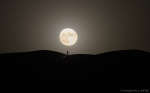 Full Moonlight
3.01.2026
The Full Moon is the brightest lunar phase, and tonight you can stand in the light of the first Full Moon of 2026. In fact, the Moon's full phase occurs on January...
|
January February March April May June July August September October |
|||||||||||||||||||||||||||||||||||||||||||||||||