
|
You entered: rings
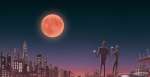 Tonight: A Supermoon Lunar Eclipse
27.09.2015
Tonight a bright full Moon will fade to red. Tonight's moon will be particularly bright because it is reaching its fully lit phase when it is relatively close to the Earth in its elliptical orbit.
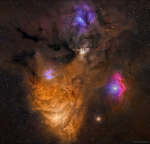 Dark Dust and Colorful Clouds near Antares
27.08.2019
Why is the sky near Antares and Rho Ophiuchi so dusty yet colorful? The colors result from a mixture of objects and processes. Fine dust illuminated from the front by starlight produces blue reflection nebulae. Gaseous clouds whose atoms are excited by ultraviolet starlight produce reddish emission nebulae.
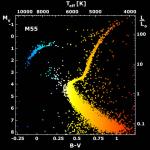 M55 Color Magnitude Diagram
23.02.2001
This color "picture" of globular star cluster M55 may not look like any star cluster you've ever seen. Still, it shows a most fundamental view for students of stellar astronomy. In the picture...
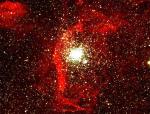 NGC 1850: Gas Clouds and Star Clusters
24.12.2000
There's nothing like it in our own Galaxy. Globular clusters as young as NGC 1850 don't exist here. Globular clusters only 40 millions of years old can still be found in the neighboring LMC galaxy, though, but perhaps none so unusual as NGC 1850.
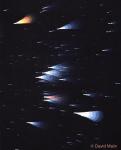 Orion's Star Colors
2.12.1996
What determines a star's color? Its temperature. Red stars are cool, with temperatures of around 3,000 degrees Kelvin (K), while blue stars are hotter and can have temperatures over 30,000 degrees K. Our own lovely yellow Sun's temperature is a comforting 6,000 degrees K.
 Shadow of a Martian Robot
29.06.2008
What if you saw your shadow on Mars and it wasn't human? Then you might be the Opportunity rover currently exploring Mars. Opportunity and sister robot Spirit have been probing the red planet since early 2004, finding evidence of ancient water, and sending breathtaking images across the inner Solar System.
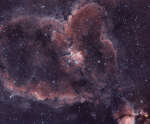 IC 1805: The Heart Nebula in HDR
25.10.2011
What powers the Heart Nebula? The large emission nebula dubbed IC 1805 looks, in whole, like a human heart. The nebula glows brightly in red light emitted by its most prominent element: hydrogen. The red glow and the larger shape are all created by a small group of stars near the nebula's center.
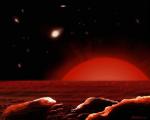 Stars Without Galaxies
19.01.2002
Galaxies are made up of stars, but are all stars found within galaxies? Using the Hubble Space Telescope, researchers exploring the Virgo Cluster of galaxies have found about 600 red giant stars adrift in intergalactic space. Above is an artist's vision of the sky from a hypothetical planet of such a lonely sun.
 Sagittarius and the Central Milky Way
5.06.1996
What does the center of our Milky Way Galaxy look like? No one knows! It is not possible to see the Galactic center in light our eyes are sensitive to because the thick dust in the plane of our Galaxy obscures it.
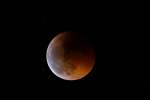 Eclipsed Moonlight
21.06.2011
A celestial prelude to today's solstice, the June 15 total lunar eclipse was one of the longest in recent years. It was also one of the darkest, but not completely dark. Even during...
|
January February March April May June July August September October |
|||||||||||||||||||||||||||||||||||||||||||||||||