
|
You entered: spacecraft
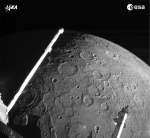 Mercury from Passing BepiColombo
28.06.2022
Which part of the Moon is this? No part -- because this is the planet Mercury. Mercury's old surface is heavily cratered like that of Earth's Moon. Mercury, while only slightly larger than Luna, is much denser and more massive than any Solar System moon because it is made mostly of iron.
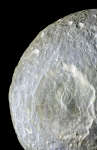 Herschel Crater on Mimas
13.08.2022
Mimas, small 400 kilometer-diameter moon of Saturn, is host to 130 kilometer-diameter Herschel crater, one of the larger impact craters in the entire Solar System. The robotic Cassini spacecraft orbiting Saturn in 2010 recorded...
 APOD: 2025 April 13 Б An Unusual Hole in Mars
13.04.2025
What created this unusual hole in Mars? Actually, there are numerous holes pictured in this Swiss cheese-like landscape, with all-but-one of them showing a dusty, dark, Martian terrain beneath evaporating, light, carbon dioxide ice.
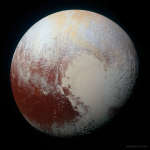 APOD: 2026 September 6 Б Pluto in Enhanced Color
6.09.2026
Pluto is more colorful than we can see. Color data and high-resolution images of our Solar System's most famous dwarf planet, taken by the robotic New Horizons spacecraft during its flyby in 2015 July, have been digitally combined to give an enhanced-color view of this ancient world sporting an unexpectedly young surface.
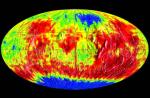 Neutron Mars
15.03.2002
Looking for water on Mars, researchers using detectors on board the orbiting Mars Odyssey spacecraft have created this false-color global map of energetic neutrons from the otherwise Red Planet. What do neutrons have to do with water?
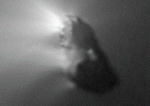 Comet Halley's Nucleus
10.12.1996
Here is what a comet nucleus really looks like. For all active comets except Halley, it was only possible to see the surrounding opaque gas cloud called the coma. During Comet Halley's most...
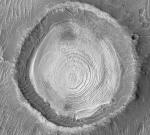 Sedimentary Mars
15.08.2003
High-resolution imaging of an area in the Schiaparelli Basin of Mars on June 3 by the MGS Mars Orbiter camera produced this stunning example of layered formations within an old impact crater. On planet...
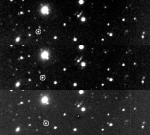 Irregular Moons Discovered Around Uranus
3.11.1997
Where did these two irregular moons of Uranus originate? Last week two previously undiscovered moons of the distant gas planet were confirmed, the first in irregular orbits. All fifteen previously known moons of Uranus are 'regular', circling near the planet's equator. Most of these were discovered by the passing Voyager 2 spacecraft in 1986.
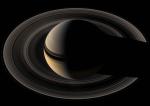 Crescent Saturn
23.10.2007
Saturn never shows a crescent phase -- from Earth. But when viewed from beyond, the majestic giant planet can show an unfamiliar diminutive sliver. This image of crescent Saturn in natural color was taken by the robotic Cassini spacecraft in May.
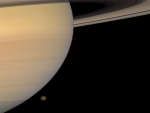 Saturn and Titan from Cassini
24.03.2008
Spectacular vistas of Saturn and its moon continue to be recorded by the Cassini spacecraft. Launched from Earth in 1997, robotic Cassini entered orbit around Saturn in 2004 and has revolutionized much of humanity's knowledge of Saturn, its expansive and complex rings, and it many old and battered moons.
|
January February March April May June July August September October |
|||||||||||||||||||||||||||||||||||||||||||||||||