
|
You entered: spacecraft
 Tetons and Snake River, Planet Earth
1.08.2014
An alluring night skyscape, this scene looks west across the Grand Teton National Park, Wyoming, USA, Planet Earth. The Snake River glides through the foreground, while above the Tetons' rugged mountain peaks the starry sky is laced with exceptionally strong red and green airglow.
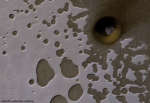 An Unusual Hole in Mars
12.06.2017
What created this unusual hole in Mars? Actually, there are numerous holes pictured in this Swiss cheese-like landscape, with all-but-one of them showing a dusty, dark, Martian terrain beneath evaporating, light, carbon-dioxide ice. The most unusual hole is on the upper right, spans about 100-meters, and seems to punch through to a lower level.
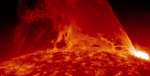 A Solar Prominence Eruption from SDO
26.05.2019
One of the most spectacular solar sights is an erupting prominence. In 2011, NASA's Sun-orbiting Solar Dynamic Observatory spacecraft imaged an impressively large prominence erupting from the surface. The dramatic explosion was captured in ultraviolet light in the featured time lapse video covering 90 minutes, where a new frame was taken every 24 seconds.
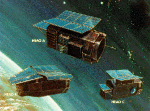 A High Energy Fleet
25.02.1996
Looking like a fleet of futuristic starcruisers poised over planet Earth, NASA's highly successful series of High Energy Astrophysical Observatory (HEAO) spacecraft appear above in a vintage illustration. Labeled A, B, and C in this conceptual picture, the spacebased telescopes were known as HEAO-1, HEAO-2, and HEAO-3 respectively.
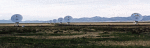 A Very Large Array of Radio Telescopes
27.07.1997
Pictured above is one of the world's premiere radio astronomical observatories: The Very Large Array (VLA). Each antenna dish is as big as a house (25 meters across) and mounted on railroad tracks. The VLA consists of 27 dishes - together capable of spanning the size of a city (35 kilometers).
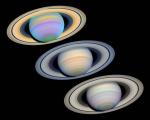 Saturn by Three
18.09.2003
These three views of Saturn were recorded by the Hubble Space Telescope on March 7th of this year, as the southern hemisphere of the solar system's most gorgeous planet reached its maximum 27 degree tilt toward Earth.
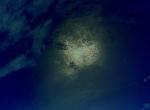 Spiral Eddies On Planet Earth
16.01.1999
Can you identify this wispy stellar nebula? How many light-years from Earth did you say? Resembling a twisting cloud of gas and dust between the stars this swirling form is actually close by - a spiral eddy formed near the North Atlantic Gulf Stream off the East coast of the U. S.
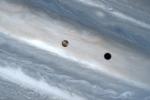 Io Shadow
23.04.1999
Orbiting Jupiter once every 43 hours, the volcanic moon Io cruises 500,000 kilometers above swirling, banded cloud-tops. Orbiting Earth once every 1.5 hours, the Hubble Space Telescope watched as Io accompanied by its shadow crossed the face of the reigning gas giant planet in 1997.
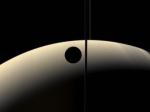 Crescent Rhea Occults Crescent Saturn
11.07.2006
Soft hues, partially lit orbs, a thin trace of the ring, and slight shadows highlight this understated view of the majestic surroundings of the giant planet Saturn. Looking nearly back toward the Sun, the robot Cassini spacecraft now orbiting Saturn captured crescent phases of Saturn and its moon Rhea in color a few months ago.
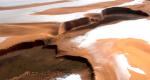 Steep Cliffs on Mars
1.07.2007
Vertical cliffs of nearly two kilometers occur near the North Pole of Mars. Also visible in the above image of the Martian North Polar Cap are red areas of rock and sand, white areas of ice, and dark areas of unknown composition but hypothesized to be volcanic ash.
|
January February March April May June July August September October |
|||||||||||||||||||||||||||||||||||||||||||||||||