
|
You entered: dark
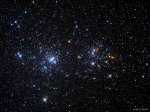 A Double Star Cluster in Perseus
17.11.2020
Most star clusters are singularly impressive. Open clusters NGC 869 and NGC 884, however, could be considered doubly impressive. Also known as "h and chi Persei", this unusual double cluster, shown above, is bright enough to be seen from a dark location without even binoculars.
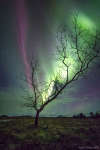 The Aurora Tree
27.02.2021
Yes, but can your tree do this? Pictured is a visual coincidence between the dark branches of a nearby tree and bright glow of a distant aurora. The beauty of the aurora -- combined with...
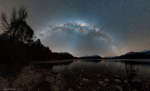 Galaxy by the Lake
9.09.2022
This 180 degree panoramic night skyscape captures our Milky Way Galaxy as it arcs above the horizon on a winter's night in August. Near midnight, the galactic center is close to the zenith with the clear waters of Lake Traful, Neuquen, Argentina, South America, planet Earth below.
 Comet Pons-Brooks at Night
3.04.2024
In dark evening skies over June Lake, northern hemisphere, planet Earth, Comet 12P/Pons-Brooks stood just above the western horizon on March 30. Its twisted turbulent ion tail and diffuse greenish coma are captured in this two degree wide telescopic field of view along with bright yellowish star Hamal also known as Alpha Arietis.
 APOD: 2024 July 31 Б Leopard Spots on Martian Rocks
30.07.2024
What is creating these unusual spots? Light-colored spots on Martian rocks, each surrounded by a dark border, were discovered earlier this month by NASA's Perseverance Rover currently exploring Mars. Dubbed leopard spots because...
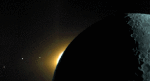 The Ecliptic Plane
14.10.2000
The Plane of the Ecliptic is well illustrated in this picture from the 1994 lunar prospecting Clementine spacecraft. Clementine's star tracker camera image reveals (from right to left) the Moon lit by Earthshine, the Sun's corona rising over the Moon's dark limb, and the planets Saturn, Mars, and Mercury.
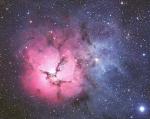 The Trifid Nebula from AAO
24.04.2002
Unspeakable beauty and unimaginable bedlam can be found together in the Trifid Nebula. Also known as M20, this photogenic nebula is visible with good binoculars towards the constellation of Sagittarius. The energetic processes of star formation create not only the colors but the chaos. The red-glowing gas results from high-energy starlight striking interstellar hydrogen gas.
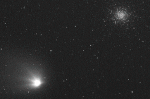 Comet Hale-Bopp Passes M14
11.11.1996
Comet Hale-Bopp continues its slow trek across the night sky, and can now be seen superposed near the bright globular cluster M14. Will Comet Hale-Bopp become as bright in early 1997 as Comet Hyakutake did in early 1996? It is still too early to tell.
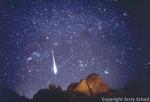 A Meteor Over the Anza Borrego Desert
11.08.1999
Meteors will be flashing across your skies over the next two nights. Specifically, the Perseid Meteor Shower should be at its best just before each morning's dawn. Observers at dark locations might see as much as a meteor a minute.
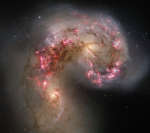 The Antennae Galaxies in Collision
18.07.2010
Two galaxies are squaring off in Corvus and here are the latest pictures. But when two galaxies collide, the stars that compose them usually do not. That's because galaxies are mostly empty space and, however bright, stars only take up only a small amount of that space.
|
January February March April May June July August September |
|||||||||||||||||||||||||||||||||||||||||||||||||