
|
You entered: dark
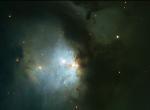 Reflection Nebula M78
24.04.2000
An eerie blue glow and ominous columns of dark dust highlight M78, a bright reflection nebula in the constellation of Orion. The dust not only absorbs light, but also reflects the light of several bright blue stars that formed recently in the nebula.
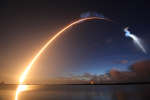 Atlas V Rising
5.09.2015
Early morning risers along Florida's Space Coast, planet Earth, were treated to a launch spectacle on September 2nd. Before dawn an Atlas V rocket rose into still dark skies carrying a US Navy communications satellite from Cape Canaveral Air Force Station into Earth orbit.
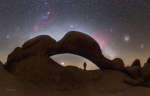 Seeking Venus under the Spitzkoppe Arch
3.11.2015
What's that in the sky? Although there was much to see in this spectacular panorama taken during the early morning hours of a day in late September, the brightest object in the sky was clearly the planet Venus.
 Bow Tie Moon and Star Trails
8.02.2018
On January 31, a leisurely lunar eclipse was enjoyed from all over the night side of planet Earth, the first of three consecutive total eclipses of the Moon. This dramatic time-lapse image followed the celestial performance for over three hours in a combined series of exposures from Hebei Province in Northern China.
 APOD: 2024 October 14 Б Comet Tsuchinshan ATLAS Over the Lincoln Memorial
14.10.2024
Go outside at sunset tonight and see a comet! C/2023 A3 (TsuchinshanБATLAS) has become visible in the early evening sky in northern locations to the unaided eye. To see the comet, look west through a sky with a low horizon.
 APOD: 2025 July 11 Б The Veins of Heaven
11.07.2025
Transfusing sunlight as the sky grew darker, this exceptional display of noctilucent clouds was captured on July 10, reflected in the calm waters of Vallentuna Lake near Stockholm, Sweden. From the edge of space...
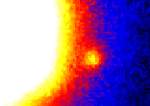 GL 229B: An Elusive Brown Dwarf?
4.12.1995
What type of matter makes up most of the universe? This question is arguably the most perplexing astronomical mystery of our time. A leading candidate is a type of dim, low mass star called a "brown dwarf" star.
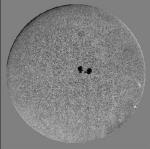 Grey Sun Seething
8.01.1997
The Sun's surface is not smooth. It has thousands of bumps called granules and usually a few dark depressions called sunspots. Each of the numerous granules is the size of an Earth continent, but much shorter lived.
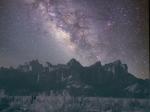 Heaven on Earth
23.02.2004
If sometimes it appears that the entire Milky Way Galaxy is raining down on your head, do not despair. It happens twice a day. As the Sun rises in the East, wonders of the night sky become less bright than the sunlight scattered by our own Earth's atmosphere, and so fade from view.
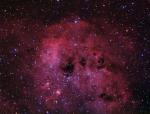 IC 410 and NGC 1893
15.08.2006
A faint, dusty rose of the northern sky, emission nebula IC 410 lies about 12,000 light-years away in the constellation Auriga. The cloud of glowing hydrogen gas is over 100 light-years across, sculpted by stellar winds and radiation from embedded open star cluster NGC 1893.
|
January February March April May June July August September |
|||||||||||||||||||||||||||||||||||||||||||||||||