
|
You entered: cluster
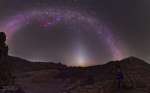 Zodiacal Light Vs. Milky Way
19.03.2010
Ghostly Zodiacal light, featured near the center of this remarkable panorama, is produced as sunlight is scattered by dust in the Solar System's ecliptic plane. In the weeks surrounding the March equinox (today...
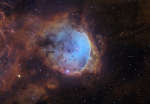 NGC 3324 in Carina
5.04.2018
This bright cosmic cloud was sculpted by stellar winds and radiation from the hot young stars of open cluster NGC 3324. With dust clouds in silhouette against its glowing atomic gas, the pocket-shaped star-forming region actually spans about 35 light-years. It lies some 7,500 light-years away toward the nebula rich southern constellation Carina.
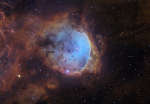 NGC 3324 in Carina
15.03.2019
This bright cosmic cloud was sculpted by stellar winds and radiation from the hot young stars of open cluster NGC 3324. With dust clouds in silhouette against its glowing atomic gas, the pocket-shaped star-forming region actually spans about 35 light-years. It lies some 7,500 light-years away toward the nebula rich southern constellation Carina.
 The Elephant s Trunk in Cepheus
20.11.2024
Like an illustration in a galactic Just So Story, the Elephant's Trunk Nebula winds through the emission region and young star cluster complex IC 1396, in the high and far off constellation of Cepheus. Also known as vdB 142, this cosmic elephant's trunk is over 20 light-years long.
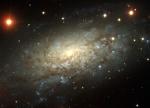 NGC 3621: Far Beyond the Local Group
5.06.2002
Far beyond the local group of galaxies lies NGC 3621, some 22 million light-years away. Found in the serpentine southern constellation Hydra, the loose spiral arms of this gorgeous island universe are loaded with luminous young star clusters and dark dust lanes.
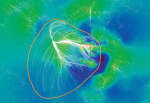 Laniakea: Our Home Supercluster of Galaxies
10.09.2014
It is not only one of the largest structures known -- it is our home. The just-identified Laniakea Supercluster of galaxies contains thousands of galaxies that includes our Milky Way Galaxy, the Local Group of galaxies, and the entire nearby Virgo Cluster of Galaxies.
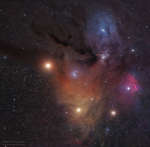 Mars in the Clouds
7.09.2016
Wandering through this stunning field of view, Mars really is in front of these colorful cosmic clouds. The mosaic contructed from telescopic images is about 5 degrees (10 full moons) across. It captures...
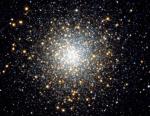 Hydrogen, Helium, and the Stars of M10
30.06.2001
Stars like the Sun use hydrogen for fuel, "burning" hydrogen into helium at their cores through nuclear fusion. But what happens when that hydrogen runs out? For a while, hydrogen burns in a shell surrounding the stellar core and the star expands to become a red giant.
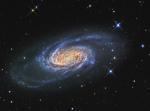 Bright Galaxy NGC 2903
6.07.2007
Spiral galaxy NGC 2903 is only some 20 million light-years distant in the constellation Leo. One of the brighter galaxies visible from the northern hemisphere, it is surprisingly missing from Charles Messier's famous catalog of celestial sights. This impressively sharp color image shows off the galaxy's beautiful blue spiral arms.
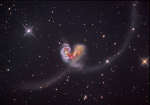 The Antennae
7.05.2010
Some 60 million light-years away in the southerly constellation Corvus, two large galaxies collided. But the stars in the two galaxies cataloged as NGC 4038 and NGC 4039 don't collide in the course of the ponderous, billion year or so long event.
|
January February March April May June July August September October |
|||||||||||||||||||||||||||||||||||||||||||||||||