
|
You entered: cluster
 The Universe Nearby
14.06.2011
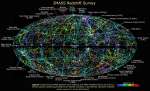
What does the universe nearby look like? This plot shows nearly 50,000 galaxies in the nearby universe detected by the Two Micron All Sky Survey (2MASS) in infrared light. The resulting image is anincredible tapestry of galaxies that provides limits on how the universe formed and evolved.
 Hitomi Launches
17.02.2016
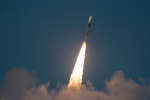
On February 17 at 5:45pm JST this H-IIA rocket blasted skyward from JAXA's Tanegashima Space Center located off the southern coast of Japan, planet Earth. Onboard was the ASTRO-H X-ray astronomy satellite, now in orbit.
 NGC 1365: Majestic Island Universe
31.01.2024
Barred spiral galaxy NGC 1365 is truly a majestic island universe some 200,000 light-years across. Located a mere 60 million light-years away toward the faint but heated constellation Fornax, NGC 1365 is a dominant member of the well-studied Fornax Cluster of galaxies.
 A Very Large Array of Radio Telescopes
20.06.1999
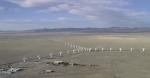
Pictured above is one of the world's premiere radio astronomical observatories: The Very Large Array (VLA). Each antenna dish is as big as a house (25 meters across) and mounted on railroad tracks. The VLA consists of 27 dishes - together capable of spanning the size of a city (35 kilometers).
 Behind CL1358+62: A New Farthest Object
31.07.1997
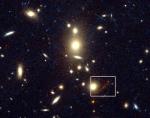
What if we could see back to the beginning of the universe? At one tenth the universe's present age, we might see galaxies forming. But what did galaxies look like when they were forming?
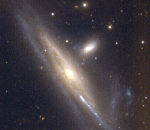 Interacting Galaxies
10.07.1998
This dramatic image of an interacting pair of galaxies was made using the 1.5 meter telescope at the Cerro Tololo Inter-American Observatory near La Serena, Chile. NGC 1531 is the background galaxy with a bright core just above center and NGC 1532 is the foreground spiral galaxy laced with dust lanes.
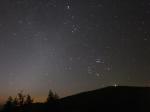 Mysterious Streaks Over Turkey
15.08.2007
What are they? Five streaks near the bottom of the above image taken near Ankara, Turkey on Sunday would be identified at first glance as meteors from the Perseids meteor shower peaking just that night. Unexpectedly, however, these streaks do not point back to the Perseids radiant in Perseus. Their origin is therefore somewhat unclear.
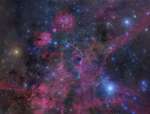 Vela Supernova Remnant
5.03.2008
The plane of our Milky Way Galaxy runs through this complex and beautiful skyscape. At the northwestern edge of the constellation Vela (the Sails) the 16 degree wide, 30 frame mosaic is centered on the glowing filaments of the Vela Supernova Remnant, the expanding debris cloud from the death explosion of a massive star.
 NGC 3621: Far Beyond the Local Group
19.09.2009
Far beyond the local group of galaxies lies NGC 3621, some 22 million light-years away. Found in the multi-headed southern constellation Hydra, the winding spiral arms of this gorgeous island universe are loaded with luminous young star clusters and dark dust lanes.
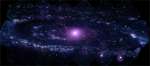 Ultraviolet Andromeda
27.10.2010
This stunning vista represents the highest resolution image ever made of the Andromeda Galaxy (aka M31) at ultraviolet wavelengths. Recorded by NASA's Swift satellite, the mosaic is composed of 330 individual images covering a region 200,000 light-years wide.
|
January February March April May June July August September October |
|||||||||||||||||||||||||||||||||||||||||||||||||