
|
You entered: cluster
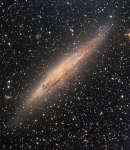 Nearby Spiral Galaxy NGC 4945
26.02.2022
Large spiral galaxy NGC 4945 is seen nearly edge-on in this cosmic galaxy close-up. It's almost the size of our Milky Way Galaxy. NGC 4945's own dusty disk, young blue star clusters, and pink star forming regions stand out in the colorful telescopic frame.
 APOD: 2023 May 29 Б Milky Way over a Turquoise Wonderland
29.05.2023
What glows there? The answer depends: sea or sky? In the sea, the unusual blue glow is bioluminescence. Specifically, the glimmer arises from Noctiluca scintillans, single-celled plankton stimulated by the lapping waves. The plankton use their glow to startle and illuminate predators.
 APOD: 2024 February 14 Б Rosette Deep Field
14.02.2024
Can you find the Rosette Nebula? The large, red, and flowery-looking nebula on the upper left may seem the obvious choice, but that is actually just diffuse hydrogen emission surrounding the Cone and Fox Fur Nebulas.
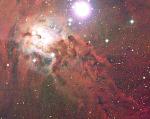 The Fox Fur Nebula
1.07.2002
The nebula surrounding bright star S Mon is filled with dark dust and glowing gas. The strange shapes that surrounding this star originate from fine interstellar dust reacting in complex ways with the energetic light and hot gas being expelled by the young stars.
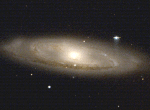 M65 Without Moth
7.08.1998
Messier 65 (M65) is a bright spiral galaxy of stars only 35 million light-years away in the constellation Leo. With very tightly wound spiral arms, a large central bulge, and well defined dust lanes, this galaxy is a member of a group of galaxies known as the Leo triplet.
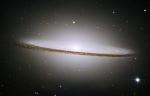 The Sombrero Galaxy from HST
15.01.2006
Why does the Sombrero Galaxy look like a hat? Reasons include the Sombrero's unusually large and extended central bulge of stars, and dark prominent dust lanes that appear in a disk that we see nearly edge-on. Billions of old stars cause the diffuse glow of the extended central bulge.
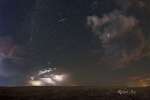 Perseid Storm
21.08.2010
Storms on the distant horizon and comet dust raining through the heavens above are combined in this alluring nightscape. The scene was recorded in the early hours of August 13 from the Keota Star Party site on the Pawnee National Grasslands of northeastern Colorado, USA.
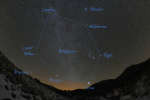 Winter Hexagon Over Stagecoach Colorado
3.01.2011
If you can find Orion, you might be able to find the Winter Hexagon. The Winter Hexagon involves some of the brightest stars visible, together forming a large and easily found pattern in the winter sky of Earth's northern hemisphere.
RGBpugh1024.preview.jpg) One Armed Spiral Galaxy NGC 4725
One Armed Spiral Galaxy NGC 4725
16.04.2015
While most spiral galaxies, including our own Milky Way, have two or more spiral arms, NGC 4725 has only one. In this sharp color composite image, the solo spira mirabilis seems to wind from a prominent ring of bluish, newborn star clusters and red tinted star forming regions.
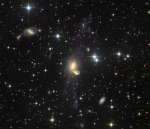 Recycling NGC 5291
21.11.2015
Following an ancient galaxy-galaxy collision 200 million light-years from Earth, debris from a gas-rich galaxy, NGC 5291, was flung far into intergalactic space. NGC 5291 and the likely interloper, also known as the "Seashell" galaxy, are captured near the center of this spectacular scene.
|
January February March April May June July August September October |
|||||||||||||||||||||||||||||||||||||||||||||||||