
|
You entered: light
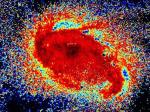 Comet-like Clouds in the Cartwheel Galaxy
28.11.1996
In a cartwheel-shaped galaxy far, far away, huge comet-shaped clouds of gas have been discovered racing through the nucleus at about 700,000 miles per hour. The aptly named Cartwheel Galaxy is actually about 500 million light years distant, its suggestive shape created by a head-on collision with a smaller galaxy.
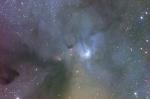 IC 4603: Reflection Nebula in Ophiuchius
21.07.2003
Why does this starfield photograph resemble an impressionistic painting? The effect is created not by digital trickery but by large amounts of interstellar dust. Dust, minute globs rich in carbon and similar in size to cigarette smoke, frequently starts in the outer atmospheres of large, cool, young stars.
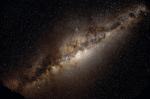 The Milky Way in Stars and Dust
4.10.2005
The disk of our Milky Way Galaxy is home to hot nebulae, cold dust, and billions of stars. This disk can be seen from a dark location on Earth as a band of diffuse light across the sky.
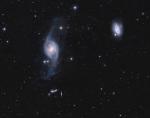 Extra Galaxies
31.08.2006
Careful inspection of the full field of view for this sharp composite image reveals a surprising number of galaxies both near and far toward the constellation Ursa Major. The most striking is clearly NGC 3718, a warped spiral galaxy found near picture center.
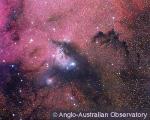 Reflections on NGC 6188
25.08.1999
NGC 6188 is an interstellar carnival of young blue stars, hot red gas, and cool dark dust. Located 4000 light years away in the disk of our Galaxy, NGC 6188 is home to the Ara OB1 association, a group of bright young stars whose nucleus forms the open cluster NGC 6193.
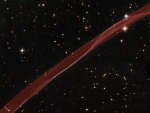 SN 1006: A Supernova Ribbon from Hubble
15.09.2008
What created this unusual space ribbon? Most assuredly, one of the most violent explosions ever witnessed by ancient humans. Back in the year 1006 AD, light reached Earth from a stellar explosion...
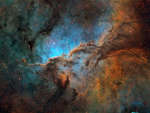 Shaping NGC 6188
16.07.2010
Dark shapes with bright edges winging their way through dusty NGC 6188 are tens of light-years long. The emission nebula is found near the edge of an otherwise dark large molecular cloud in the southern constellation Ara, about 4,000 light-years away.
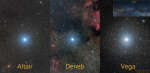 Stars of a Summer Triangle
27.06.2015
Rising at the start of a northern summer's night, these three bright stars form the familiar asterism known as the Summer Triangle. Altair, Deneb, and Vega are the alpha stars of their respective constellations, Aquila, Cygnus, and Lyra, nestled near the Milky Way.
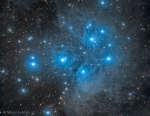 M45: The Pleiades Star Cluster
1.09.2019
Have you ever seen the Pleiades star cluster? Even if you have, you probably have never seen it as dusty as this. Perhaps the most famous star cluster on the sky, the bright stars of the Pleiades can be seen without binoculars from even the depths of a light-polluted city.
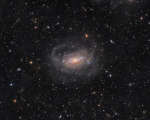 Curly Spiral Galaxy M63
4.12.2020
A bright spiral galaxy of the northern sky, Messier 63 is nearby, about 30 million light-years distant toward the loyal constellation Canes Venatici. Also cataloged as NGC 5055, the majestic island universe is nearly 100,000 light-years across, about the size of our own Milky Way.
|
January February March April May June July August September October |
|||||||||||||||||||||||||||||||||||||||||||||||||