
|
You entered: light
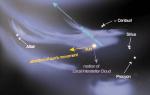 The Local Interstellar Cloud
11.04.2000
The stars are not alone. In the disk of our Milky Way Galaxy about 10 percent of visible matter is in the form of gas, called the interstellar medium (ISM). The ISM is not uniform, and shows patchiness even near our Sun.
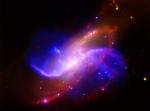 The Arms of NGC 4258
11.04.2007
Better known as M106, bright spiral galaxy NGC 4258 is about 30 thousand light years across and 21 million light years away toward the northern constellation Canes Venatici. The yellow and red hues in this composite image show the galaxy's sweeping spiral arms as seen in visible and infrared light.
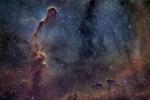 The Elephant s Trunk in IC 1396
18.10.2007
Like an illustration in a galactic Just So Story, the Elephant's Trunk Nebula winds through the emission nebula and young star cluster complex IC 1396, in the high and far off constellation of Cepheus. Of course, this cosmic elephant's trunk is over 20 light-years long.
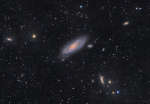 The View Toward M106
15.01.2016
A big, bright, beautiful spiral, Messier 106 is at the center of this galaxy filled cosmic vista. The two degree wide telescopic field of view looks toward the well-trained constellation Canes Venatici, near the handle of the Big Dipper.
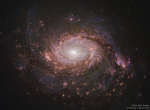 M77: Spiral Galaxy with an Active Center
16.03.2020
What's happening in the center of nearby spiral galaxy M77? The face-on galaxy lies a mere 47 million light-years away toward the constellation of the Sea Monster (Cetus). At that estimated distance, this gorgeous island universe is about 100 thousand light-years across.
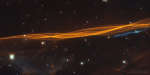 Filaments of the Cygnus Loop
27.09.2020
What lies at the edge of an expanding supernova? Subtle and delicate in appearance, these ribbons of shocked interstellar gas are part of a blast wave at the expanding edge of a violent stellar explosion that would have been easily visible to humans during the late stone age, about 20,000 years ago.
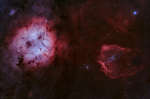 Elephant, Bat, and Squid
22.07.2021
Sprawling emission nebulae IC 1396 and Sh2-129 mix glowing interstellar gas and dark dust clouds in this 10 degree wide field of view toward the northern constellation Cepheus the King. Energized by its bluish central star IC 1396 (left) is hundreds of light-years across and some 3,000 light-years distant.
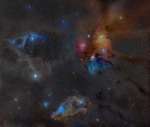 Rho Ophiuchus Wide Field
24.05.2010
The clouds surrounding the star system Rho Ophiucus compose one of the closest star forming regions. Rho Ophiucus itself is a binary star system visible in the light-colored region on the image right.
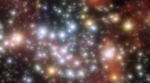 Journey to the Center of the Galaxy
28.07.2018
What wonders lie at the center of our Galaxy? In Jules Verne's science fiction classic A Journey to the Center of the Earth, Professor Liedenbrock and his fellow explorers encounter many strange and exciting wonders.
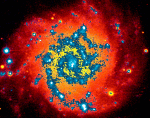 M74: A Grand Design Spiral Galaxy
9.07.1996
M74 is about the same size as our own Milky Way Galaxy. Like our Milky Way, M74 is classified a spiral galaxy. M74's sweeping lanes of stars and dust combined with its small nucleus make it a classic Grand Design Spiral. On the Hubble Sequence of Galaxies, M74 is listed as "Sc".
|
January February March April May June July August September October |
|||||||||||||||||||||||||||||||||||||||||||||||||