
|
You entered: light
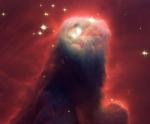 Cone Nebula Close Up
29.05.2004
Cones, pillars, and majestic flowing shapes abound in stellar nurseries where natal clouds of gas and dust are buffeted by energetic winds from newborn stars. A well-known example, the Cone Nebula within the bright galactic star-forming region NGC 2264, was captured in this close-up view from the Hubble Space Telescope's Advanced Camera for Surveys.
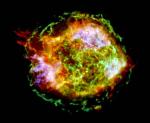 APOD: 2004 August 26- Cassiopeia A in a Million
26.08.2004
One million seconds of x-ray image data were used to construct this view of supernova remnant Cassiopeia A, the expanding debris cloud from a stellar explosion. The stunningly detailed image from the Chandra Observatory will allow an unprecedented exploration of the catastrophic fate that awaits stars much more massive than the Sun.
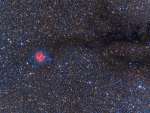 Cocoon Nebula Wide Field
29.09.2011
In this crowded starfield spanning some 3 degrees within the high flying constellation Cygnus, the eye is drawn to the Cocoon Nebula. A compact star forming region, the cosmic Cocoon punctuates a long trail of obscuring interstellar dust clouds.
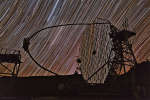 MAGIC Star Trails
14.10.2011
Colorful star trails arc across the night in this surreal timelapse skyscape from the Roque de los Muchachos Observatory on the Canary island of La Palma. A reflection of the Earth's daily rotation on its axis, the star trails are also reflected in one of a pair of 17 meter diameter, multi-mirrored MAGIC telescopes.
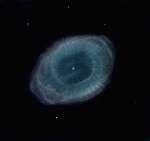 Ring Nebula Drawn
15.09.2012
A planetary nebula with a simple symmetry familiar to telescopic sky gazers, the Ring Nebula (M57) is some 2,000 light-years away in the musical constellation Lyra. Hints of changing colors and subtle details are brought out in this remarkable sketch of the cosmic ring.
 Hydrogen Clouds of M33
13.10.2023
Gorgeous spiral galaxy Messier 33 seems to have more than its fair share of glowing hydrogen gas. A prominent member of the local group of galaxies, M33 is also known as the Triangulum Galaxy and lies a mere 3 million light-years away.
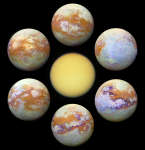 APOD: 2026 May 2 Б Seeing Titan
2.05.2026
Shrouded in a thick atmosphere, the surface of Saturn's largest moon, Titan, is really hard to see. Small particles suspended in Titan's upper atmosphere cause an almost impenetrable haze, strongly scattering light at visible wavelengths and hiding surface features from prying eyes.
 Paris by Night
31.03.2012
Do you recognize the city lights of Paris in this picture? Taken on March 25 from the top of the 210 meter tall Montparnasse skyscraper, many will spot the looming Eiffel Tower, or the large domed structure of Les Invalides (right), or the colorfully lit elevated Metro train line gently curving toward picture center.
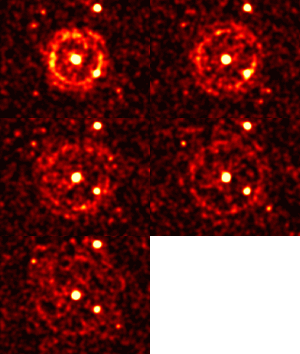 X Ray Rings Expand from a Gamma Ray Burst
30.01.2004
Why do x-ray rings appear to emanate from a gamma-ray burst? The surprising answer has little to do with the explosion itself but rather with light reflected off sheets of dust-laden gas in our own Milky Way Galaxy.
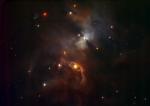 Stars Forming in Serpens
31.08.2007
Stars are forming in a dense molecular cloud a mere 1,000 light-years away in the constellation Serpens Cauda (The Serpent's Tail). At that estimated distance, this sharp, near-infrared close-up of the active Serpens star-forming region spans about 2 arcminutes or just over half a light-year.
|
January February March April May June July August September October |
|||||||||||||||||||||||||||||||||||||||||||||||||