
|
You entered: light
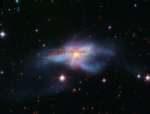 NGC 6240: Merging Galaxies
18.06.2009
NGC 6240 offers a rare glimpse of a cosmic catastrophe in its final throes. The titanic galaxy-galaxy collision is located a mere 400 million light-years away in the constellation Ophiuchus. One of the brightest...
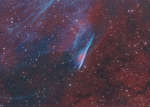 NGC 2736: The Pencil Nebula
21.03.2013
Moving left to right near the center of this beautifully detailed color composite, the thin, bright, braided filaments are actually long ripples in a sheet of glowing gas seen almost edge on. The interstellar shock wave plows through space at over 500,000 kilometers per hour.
 Peculiar Galaxies of Arp 273
9.01.2025
The colorful, spiky stars are in the foreground of this image taken with a small telescope on planet Earth. They lie well within our own Milky Way Galaxy. But the two eye-catching galaxies in the frame lie far beyond the Milky Way, at a distance of over 300 million light-years.
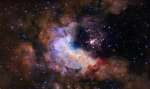 Celestial Fireworks: Into Star Cluster Westerlund 2
4.07.2017
What if you could go right into a cluster where stars are forming? A one-minute, time-lapse, video visualization of just this has been made with 3D computer modeling of the region surrounding the star cluster Westerlund 2, based on images from the Hubble Space Telescope in visible and infrared light.
 APOD: 2025 August 24 Б The Spinning Pulsar of the Crab Nebula
24.08.2025
At the core of the Crab Nebula lies a city-sized, magnetized neutron star spinning 30 times a second. Known as the Crab Pulsar, it is the bright spot in the center of the gaseous swirl at the nebula's core.
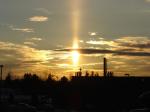 A Sun Pillar Over Maine
2.01.2006
Have you ever seen a sun pillar? When the air is cold and the Sun is rising or setting, falling ice crystals can reflect sunlight and create an unusual column of light. Ice sometimes forms flat, stop-sign shaped crystals as it falls from high-level clouds.
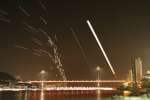 Hong Kong Sky
6.02.2010
This remarkable scene combines multiple exposures recorded on the evening of January 18th from a waterside perspective in Hong Kong, China. It follows a young crescent Moon, with brilliant planet Jupiter to its left, as they set together in the western sky. Their two luminous trails are faintly paralleled by trails of background stars.
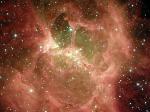 Spooky Star Forming Region DR 6
1.11.2004
How could stars form such a spooky and familiar shape as a human skull? First, the complex process of star formation creates nebulas of many shapes and sizes -- it is human perception that identifies the skull shape.
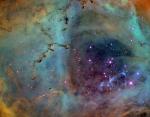 When Roses Aren t Red
24.03.2006
Not all roses are red of course, but they can still be very pretty. Likewise, the beautiful Rosette Nebula and other star forming regions are often shown in astronomical images with a predominately red hue - in part because the dominant emission in the nebula is from hydrogen atoms.
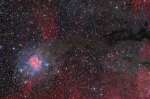 Cocoon Nebula Wide Field
13.09.2012
In this crowded starfield covering over 2 degrees within the high flying constellation Cygnus, the eye is drawn to the Cocoon Nebula. A compact star forming region, the cosmic Cocoon punctuates a long trail of obscuring interstellar dust clouds.
|
January February March April May June July August September October |
|||||||||||||||||||||||||||||||||||||||||||||||||