
|
You entered: light
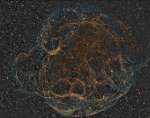 Simeis 147: Supernova Remnant
30.01.2009
It's easy to get lost following the intricate filaments in this detailed image of faint supernova remnant Simeis 147. Also cataloged as Sh2-240 and seen towards the constellation Taurus, it covers nearly 3 degrees (6 full moons) on the sky.
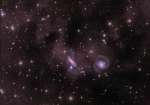 Dust and the NGC 7771 Group
20.01.2010
Galaxies of the NGC 7771 Group are featured in this intriguing skyscape. Some 200 million light-years distant toward the constellation Pegasus, NGC 7771 is the large, edge-on spiral near center, about 75,000 light-years across, with two smaller galaxies just below it. Large spiral NGC 7769 is seen face-on to the right.
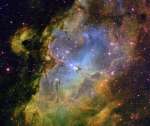 The Eagle Nebula from Kitt Peak
16.04.2012
From afar, the whole thing looks like an Eagle. A closer look at the Eagle Nebula, however, shows the bright region is actually a window into the center of a larger dark shell of dust. Through this window, a brightly-lit workshop appears where a whole open cluster of stars is being formed.
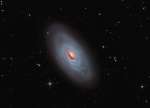 M64: The Black Eye Galaxy
4.04.2013
This beautiful, bright, spiral galaxy is Messier 64, often called the Black Eye Galaxy or the Sleeping Beauty Galaxy for its heavy-lidded appearance in telescopic views. M64 is about 17 million light-years distant in the otherwise well-groomed northern constellation Coma Berenices.
 Cat s Eye Wide and Deep
27.05.2016
The Cat's Eye Nebula (NGC 6543) is one of the best known planetary nebulae in the sky. Its more familiar outlines are seen in the brighter central region of the nebula in this impressive wide-angle view. But the composite image combines many short and long exposures to also reveal an extremely faint outer halo.
 APOD: 2023 December 19 Б NGC 1499: The California Nebula
18.12.2023
Could Queen Calafia's mythical island exist in space? Perhaps not, but by chance the outline of this molecular space cloud echoes the outline of the state of California, USA. Our Sun has its home within the Milky Way's Orion Arm, only about 1,000 light-years from the California Nebula.
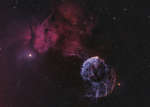 Sharpless 249 and the Jellyfish Nebula
26.02.2026
Normally faint and elusive, the Jellyfish Nebula is caught in this alluring telescopic field of view. Floating in the interstellar sea, the nebula is anchored right and left by two bright stars, Mu and Eta Geminorum, at the foot of the celestial twins.
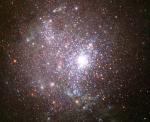 The Stars of NGC 1705
23.04.2003
Some 2,000 light-years across, NGC 1705 is small as galaxies go, similar to our Milky Way's own satellite galaxies, the Magellanic Clouds. At a much larger distance of 17 million light-years...
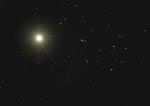 Venus and the Pleiades
15.04.2004
Venus still rules the western skies after sunset as the brilliant evening star. While wandering the ecliptic with its fellow naked-eye planets earlier this month, it passed near the Pleiades star cluster, providing a striking photo opportunity for earthbound skygazers.
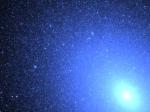 M32: Blue Stars in an Elliptical Galaxy
2.11.1999
Elliptical galaxies are known for their old, red stars. But is this old elliptical up to new tricks? In recent years, the centers of elliptical galaxies have been found to emit unexpectedly high amounts of blue and ultraviolet light.
|
January February March April May June July August September October |
|||||||||||||||||||||||||||||||||||||||||||||||||