
|
You entered: light
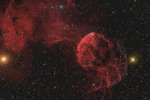 Elusive Jellyfish Nebula
14.05.2009
Normally faint and elusive, the Jellyfish Nebula is caught in this alluring wide-field telescopic view. Flanked by two yellow-tinted stars, Mu and Eta Geminorum, at the foot of a celestial twin, the Jellyfish Nebula is the brighter arcing ridge of emission with dangling tentacles right of center.
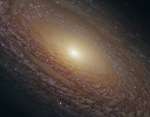 Spiral Galaxy NGC 2841 Close Up
19.02.2011
A mere 46 million light-years distant, spiral galaxy NGC 2841 can be found in the northern constellation of Ursa Major. This sharp view of the gorgeous island universe shows off a striking yellow nucleus and galactic disk.
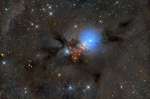 NGC 1333: Stellar Nursery in Perseus
5.11.2015
NGC 1333 is seen in visible light as a reflection nebula, dominated by bluish hues characteristic of starlight reflected by interstellar dust. A mere 1,000 light-years distant toward the heroic constellation Perseus, it lies at the edge of a large, star-forming molecular cloud.
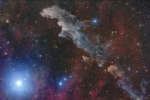 Rigel and the Witch Head Nebula
15.01.2018
By starlight this eerie visage shines in the dark, a crooked profile evoking its popular name, the Witch Head Nebula. In fact, this entrancing telescopic portrait gives the impression that the witch has fixed her gaze on Orion's bright supergiant star Rigel.
 NGC 6888: The Crescent Nebula
28.11.2025
NGC 6888, also known as the Crescent Nebula, is a about 25 light-years across, a cosmic bubble blown by winds from its central, massive star. This deep telescopic image includes narrowband image data, to isolate light from hydrogen and oxygen atoms.
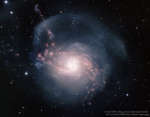 APOD: 2026 April 5 Б NGC 3310: A Starburst Spiral Galaxy
5.04.2026
The party is still going on in spiral galaxy NGC 3310. Roughly 100 million years ago, NGC 3310 likely collided with a smaller galaxy causing the large spiral galaxy to light up with a tremendous burst of star formation.
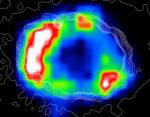 X-Ray Ring Around SN1987A
12.05.2000
This false-color image from the Chandra X-ray Observatory reveals a one light-year diameter ring of hot, ten million degree plasma. It is one of the most detailed X-ray images of the expanding blast wave from supernova 1987A (SN1987A).
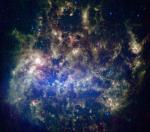 The Large Magellanic Cloud in Infrared
4.09.2006
Where does dust collect in galaxies? To help find out, a team of researchers took the most detailed image ever of gas clouds and dust in the neighboring Large Magellanic Cloud (LMC) galaxy.
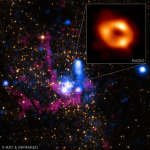 The Milky Way s Black Hole
13.05.2022
There's a black hole at the center of the Milky Way. Stars are observed to orbit a very massive and compact object there known as Sgr A* (say "sadge-ay-star"). But this just released...
 A Beautiful Trifid
1.09.2003
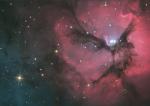
The beautiful Trifid Nebula (aka M20), a photogenic study in cosmic contrasts, lies about 5,000 light-years away toward the nebula rich constellation Sagittarius. A star forming region in the plane of our galaxy...
|
January February March April May June July August September October |
|||||||||||||||||||||||||||||||||||||||||||||||||