
|
You entered: apod
 An Almost Total Lunar Eclipse
19.11.2021
Predawn hours of November 19 found the Moon in partly cloudy skies over Cancun, Mexico. Captured in this telephoto snapshot, the lunar disk is not quite entirely immersed in Earth's dark umbral shadow during a long partial lunar eclipse.
 Leonids from the Road
25.11.2001
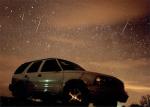
Sometimes you just have to stop and watch the meteors. In the early morning hours of November 18, a band of eleven people searched for a flat and cloudless site to see the 2001 Leonids Meteor Shower.
 Debris Disks Surround Distant Suns
9.12.2004
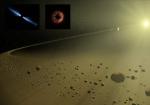
In this dramatic artist's vision, debris along the outer reaches of a planet forming disk orbits in the glare of a distant sun. But inset are actual images of such disks around two nearby stars - AU Microscopii (top left; edge-on) and HD107146 (right: face-on) - as seen by the Hubble Space Telescope.
 NGC 7635: Bubble in a Cosmic Sea
22.11.2016
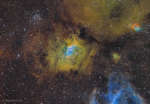
Do you see the bubble in the center? Seemingly adrift in a cosmic sea of stars and glowing gas, the delicate, floating apparition in this widefield view is cataloged as NGC 7635 - The Bubble Nebula.
 Zodiacal Light and the False Dawn
16.01.2012
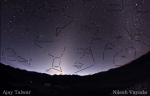
Is it dawn or false dawn? During certain times of the year, the horizon near the rising Sun will begin to glow unusually early. This early glow does not originate directly from the Sun, but rather from sunlight reflected by interplanetary dust.
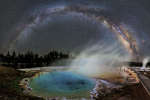 Milky Way over Yellowstone
27.08.2014
The Milky Way was not created by an evaporating lake. The colorful pool of water, about 10 meters across, is known as Silex Spring and is located in Yellowstone National Park in Wyoming, USA. Illuminated artificially, the colors are caused by layers of bacteria that grow in the hot spring.
 Stars and Gas of the Running Chicken Nebula
30.05.2016
To some, it looks like a giant chicken running across the sky. To others, it looks like a gaseous nebula where star formation takes place. Cataloged as IC 2944, the Running Chicken Nebula spans about 100 light years and lies about 6,000 light years away toward the constellation of the Centaur (Centaurus).
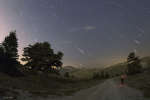 Perseid Meteors over Turkey
31.07.2017
The Perseid Meteor Shower, usually the best meteor shower of the year, will peak late next week. A person watching a clear sky from a dark location might see a bright meteor every minute.
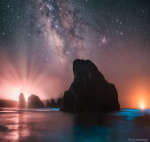 Sea and Sky Glows over the Oregon Coast
3.09.2022
Every step caused the sand to light up blue. That glow was bioluminescence -- a blue radiance that also lights the surf in this surreal scene captured in mid-2018 at Meyer's Creek Beach in Oregon, USA. Volcanic stacks dot the foreground sea, while a thin fog layer scatters light on the horizon.
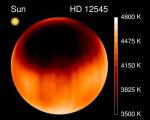 A Giant Starspot on HD 12545
1.11.2003
What could cause a star to have such a large spot? Our Sun itself frequently has sunspots, relatively cool dark magnetic depressions that move across its surface. HD 12545, however, exhibits the largest starspots yet observed.
|
January February March April May June July August |
||||||||||||||||||||||||||||||||||||||||||||||||||||||||