
|
You entered: color
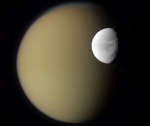 Saturns Moons Dione and Titan from Cassini
20.04.2010
What would it be like to see a sky with many moons? Such is the sky above Saturn. When appearing close to each other, moons will show a similar phase. A view with...
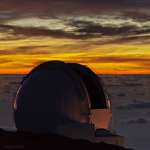 Clouds, Comet, and Crescent Moon
14.03.2013
In silhouette against the colorful evening twilight glow, clouds part in this much anticipated magic moment. The scene captures naked-eye Comet PanSTARRS peeking into northern hemisphere skies on March 12. The comet stands over the western horizon after sunset, joined by the thin, flattened crescent of a day old Moon.
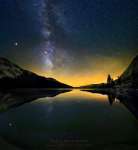 Six Planets from Yosemite
14.06.2018
The five naked-eye planets, Mercury, Venus, Mars, Jupiter and Saturn, have been seen since ancient times to wander the night skies of planet Earth. So it could be remarkable that on this night, standing at the side of a clear, calm lake, six planets can be seen with the unaided eye. Have a look.
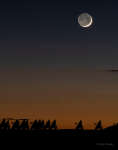 The Old Moon in the Young Moon s Arms
10.11.2018
Tonight the Moon is young again, but this stunning image of a young Moon near the western horizon was taken just after sunset on October 10. On the lunar disk Earthshine, earthlight reflected from the Moon's night side, is embraced by the slim, sunlit crescent just over 2 days old.
 NGC 6822: Barnard s Galaxy
2.12.2021
Grand spiral galaxies often seem to get all the glory, flaunting their young, bright, blue star clusters in beautiful, symmetric spiral arms. But small galaxies form stars too, like nearby NGC 6822, also known as Barnard's Galaxy.
 Jupiter by Moonlight
3.11.2023
That bright beacon you've seen rising in the east just after sunset is Jupiter. Climbing high in midnight skies, our Solar System's ruling gas giant was at its 2023 opposition, opposite the Sun in planet Earth's sky, on November 2.
 Irregular Dwarf Galaxy Sextans A
29.05.2025
Grand spiral galaxies often seem to get all the attention, flaunting young, bright, blue star clusters and pinkish star forming regions along graceful, symmetric spiral arms. But small galaxies form stars too, like irregular dwarf galaxy Sextans A.
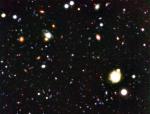 The NTT SUSI Deep Field
15.09.1998
What happens if you point a large telescope at nothing? The above New Technology Telescope SUSI Deep Field photograph isolated a small patch of sky picked to contain no bright objects at all.
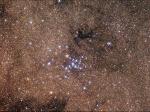 The M7 Open Star Cluster in Scorpius
6.04.2005
M7 is one of the most prominent open clusters of stars on the sky. The cluster, dominated by bright blue stars, can be seen with the naked eye in a dark sky in the tail of the constellation of Scorpius.
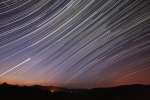 Star Trails at Dawn
8.12.2007
Just fix your camera to a tripod and you too can make an image of graceful trails traced by the stars as planet Earth rotates on its axis. Made on September 14 from Montlaux...
|
January February March April May June July August September October |
|||||||||||||||||||||||||||||||||||||||||||||||||