
|
You entered: color
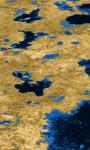 Liquid Lakes on Saturns Titan
7.02.2007
Why would some regions on Titan reflect very little radar? The leading explanation is that these regions are lakes, possibly composed of liquid methane. The above image is a false-color synthetic radar map of a northern region of Titan taken during a flyby of the cloudy moon by the robotic Cassini spacecraft last July.
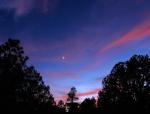 Red, White, and Blue Sky
4.07.2007
Contrasting colors in this beautiful sunset sky were captured on June 30 from Clear Creek Canyon Observatory in central Arizona, USA. The twilight scene includes brilliant Venus as the evening star, with a bright Saturn just above it, shining through thin clouds.
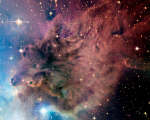 The Fox Fur Nebula from CFHT
22.04.2008
This interstellar beast is formed of cosmic dust and gas interacting with the energetic light and winds from hot young stars. The shape, visual texture, and color, combine to give the region the popular name Fox Fur Nebula.
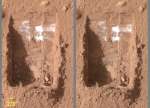 Vanishing Act
21.06.2008
Compare these two close-up pictures taken on sol 20 (left) and sol 24 of a trench dug in the Martian surface by NASA's Phoenix Lander. Those sols of the Phoenix Mission (a sol is a Martian day), correspond to June 15 and 18 on planet Earth.
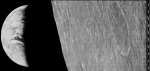 Restored: First Image of the Earth from the Moon
18.11.2008
Pictured above is the first image ever taken of the Earth from the Moon. The image was taken in 1966 by Lunar Orbiter 1 and heralded by then-journalists as the Image of the Century. It was taken about two years before the Apollo 8 crew snapped its more famous color cousin.
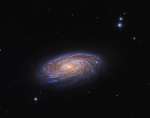 Messier 88
30.01.2010
Charles Messier described the 88th entry in his 18th century catalog of Nebulae and Star Clusters as a spiral nebula without stars. Of course the gorgeous M88 is now understood to be a galaxy full of stars, gas, and dust, not unlike our own Milky Way.
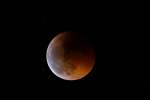 Eclipsed Moonlight
21.06.2011
A celestial prelude to today's solstice, the June 15 total lunar eclipse was one of the longest in recent years. It was also one of the darkest, but not completely dark. Even during...
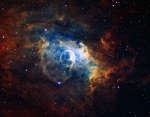 NGC 7635: The Bubble Nebula
11.10.2011
It's the bubble versus the cloud. NGC 7635, the Bubble Nebula, is being pushed out by the stellar wind of massive central star BD+602522. Next door, though, lives a giant molecular cloud, visible to the right. At this place in space, an irresistible force meets an immovable object in an interesting way.
 Stars and Gas of the Running Chicken Nebula
31.05.2016
To some, it looks like a giant chicken running across the sky. To others, it looks like a gaseous nebula where star formation takes place. Cataloged as IC 2944, the Running Chicken Nebula spans about 100 light years and lies about 6,000 light years away toward the constellation of the Centaur (Centaurus).
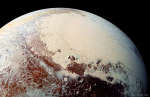 Plutos Sputnik Planum
22.11.2016
Is there an ocean below Sputnik Planum on Pluto? The unusually smooth 1000-km wide golden expanse, visible in the featured image from New Horizons, appears segmented into convection cells. But how was this region created?
|
January February March April May June July August September October |
|||||||||||||||||||||||||||||||||||||||||||||||||