
|
You entered: color
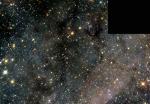 A Magellanic Starfield
12.12.1999
Stars of many types and colors are visible in this Hubble Space Telescope vista of the Large Magellanic Cloud (LMC). Over 10,000 stars are visible -- the brightest of which are giant stars. Were our Sun 170,000 light-years distant and among these stars, it would hardly be discernable.
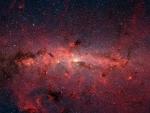 Stars of the Galactic Center
9.02.2007
The center of our Milky Way Galaxy is hidden from the prying eyes of optical telescopes by clouds of obscuring dust and gas. But in this stunning vista, the Spitzer Space Telescope's infrared cameras, penetrate much of the dust revealing the stars of the crowded galactic center region.
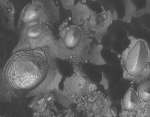 Layered Hills in Arabia Terra on Mars
15.08.2010
Why are some hills on Mars so layered? The answer is still under investigation. Clearly, dark windblown sand surrounds outcropping of light sedimentary rock across the floor of crater Arabia Terra. The light rock clearly appears structured into many layers, the lowest of which is likely very old.
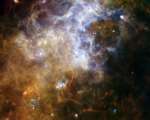 Herschel Views the Milky Way
2.09.2011
With a 3.5 meter diameter mirror, larger than the Hubble Space Telescope, ESA's Herschel Space Observatory explores the Universe at infrared wavelengths. Herschel is named for German-born British astronomer Frederick William Herschel who discovered infrared light over 200 years ago.
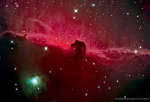 The Horsehead Nebula
31.12.2013
The Horsehead Nebula is one of the most famous nebulae on the sky. It is visible as the dark indentation to the red emission nebula in the center of the above photograph. The horse-head feature is dark because it is really an opaque dust cloud that lies in front of the bright red emission nebula.
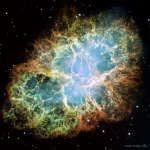 M1: The Crab Nebula from Hubble
15.08.2015
This is the mess that is left when a star explodes. The Crab Nebula, the result of a supernova seen in mysterious filaments. The filaments are not only tremendously complex, but appear to have less mass than expelled in the original supernova and a higher speed than expected from a free explosion.
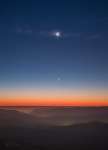 Las Campanas Moon and Mercury
5.08.2016
Last Thursday the view toward sunset from the 2.5 kilometer summit of Cerro Las Campanas in the remote Chilean Andes was amazing. Bright but fading Mercury stood very close to a two day old Moon. Both a sunlit lunar crescent and earthlit lunar nightside are captured with the fleeting innermost planet in this breathtaking mountainscape.
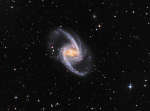 NGC 1365: Majestic Island Universe
11.10.2017
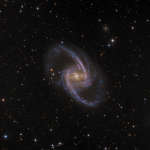
Barred spiral galaxy NGC 1365 is truly a majestic island universe some 200,000 light-years across. Located a mere 60 million light-years away toward the chemical constellation Fornax, NGC 1365 is a dominant member of the well-studied Fornax galaxy cluster.
 NGC 1365: Majestic Island Universe
7.01.2021
Barred spiral galaxy NGC 1365 is truly a majestic island universe some 200,000 light-years across. Located a mere 60 million light-years away toward the chemical constellation Fornax, NGC 1365 is a dominant member of the well-studied Fornax Cluster of galaxies.
 The Regolith of Asteroid Eros
29.08.2000
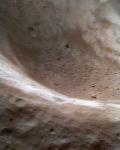
From fifty kilometers above asteroid Eros, the surface inside one of its largest craters appears covered with an unusual substance: regolith. The thickness and composition of the surface dust that is regolith remains a topic of much research.
|
January February March April May June July August September October |
|||||||||||||||||||||||||||||||||||||||||||||||||