
|
You entered: color
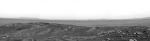 The View from Husband Hill on Mars
7.09.2005
Scroll right to see a breathtaking panorama of Mars from the top of Husband Hill. The image was taken by the robotic rover Spirit now exploring the red planet. Spirit, situated in expansive Gusev Crater, has been exploring the Columbia Hills for some time including climbing Husband Hill over the last few months.
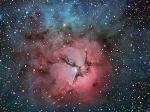 The Trifid Nebula in Stars and Dust
13.08.2007
Unspeakable beauty and unimaginable bedlam can be found together in the Trifid Nebula. Also known as M20, this photogenic nebula is visible with good binoculars towards the constellation of Sagittarius. The energetic processes of star formation create not only the colors but the chaos. The red-glowing gas results from high-energy starlight striking interstellar hydrogen gas.
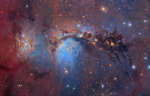 M78: Stardust and Starlight
10.10.2013
Interstellar dust clouds and bright nebulae abound in the fertile constellation of Orion. One of the brightest, M78, is just left of center in this colorful telescopic view, covering an area north of Orion's belt. At a distance of about 1,500 light-years, the bluish nebula itself is about 5 light-years across.
 APOD: 2025 September 6 Б Sardinia Sunset
6.09.2025
When the sun sets on September 7, the Full Moon will rise. And on that date denizens around much of our fair planet, including parts of Antarctica, Australia, Asia, Europe, and Africa can witness a total lunar eclipse, with the Moon completely immersed in Earth's shadow.
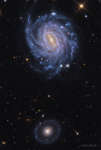 APOD: 2026 May 26 Б NGC 3660 and Burcins Galaxy
26.05.2026
The upper galaxy might be more photogenic, but the lower galaxy is more unusual. The galaxy up top is NGC 3660, a spiral galaxy similar to our own Milky Way galaxy in that it has several bright blue spiral arms and a central bar of stars, dust, and gas.
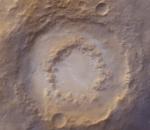 A Frosty Crater On Mars
1.12.2000
In the martian southern hemisphere, autumn has arrived. As on planet Earth, the cooler temperatures bring a seasonal frost to the landscape. Of course on Mars, the surface temperatures can be really cool, reaching below minus 100 degrees C.
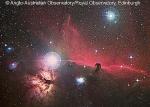 Orion's Horsehead Nebula
27.08.2000
The Horsehead Nebula is one of the most famous nebulae on the sky. It is visible as the black indentation to the red emission nebula seen just to the right of center of the above photograph. The bright star near the center is located in the belt of the familiar constellation of Orion.
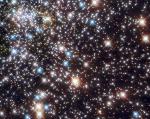 Oddities of Star Cluster NGC 6397
20.02.2002
One of these stars is blinking. This star, a member of globular cluster NGC 6397, is noteworthy not just because it blinks, but because it blinks so fast and because its companion star is so atypical.
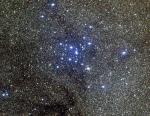 The M7 Open Star Cluster in Scorpius
5.05.2002
M7 is one of the most prominent open clusters of stars on the sky. The cluster, dominated by bright blue stars, can be seen with the naked eye in a dark sky in the tail of the constellation of Scorpius.
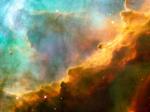 M17: A Hubble Close Up
25.04.2003
Sculpted by stellar winds and radiation, these fantastic, undulating shapes lie within the stellar nursery known as M17, the Omega Nebula, some 5,500 light-years away in the nebula-rich constellation Sagittarius. The lumpy features...
|
January February March April May June July August September October |
|||||||||||||||||||||||||||||||||||||||||||||||||