
|
You entered: color
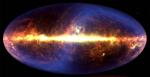 The Infrared Sky
28.01.1998
Three major sources contribute to the far-infrared sky: our Solar System, our Galaxy, and our Universe. The above image, in representative colors, is a projection of the entire infrared sky created from years of observations by the robot spacecraft COBE.
 Comet NEAT (Q4) Over Indian Cove
18.05.2004
Comet NEAT (Q4) was quite photogenic earlier this month. Although the head and part of the tails of Comet C/2001 Q4 (NEAT) were visible to the unaided eye, the best views of the colorful tail were revealed only later by cameras able to expose for long periods.
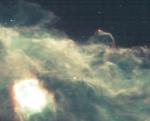 Infrared Horsehead
6.08.1998
This famous cosmic dust cloud was imaged in infrared light by the European Space Agency's Infrared Space Observatory (ISO) satellite. The false-color picture shows the bright infrared emission from dust and molecular gas in part of the Orion star forming region surrounding the Horsehead Nebula.
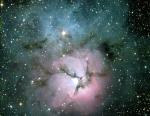 M20: The Trifid Nebula
28.03.2000
Unspeakable beauty and unimaginable bedlam can be found together in the Trifid Nebula. Also known as M20, this photogenic nebula is visible with good binoculars towards the constellation of Sagittarius. The energetic processes of star formation create not only the colors but the chaos. The red-glowing gas results from high-energy starlight striking interstellar hydrogen gas.
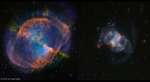 The Dumbells
17.12.2008
These two nebulae are cataloged as M27 (left) and M76, popularly known as The Dumbbell and the Little Dumbbell. Not intended to indicate substandard mental prowess, their popular names refer to their similar, dumbbell or hourglass shapes.
 Discovery s Cloud
8.04.2010
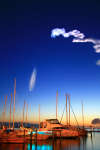
The space shuttle orbiter Discovery is now docked with the International Space Station, some 350 kilometers above planet Earth. Last Monday, its launch to orbit was a beautiful one as it rose into clear, predawn skies at 6:21am EDT from Kennedy Space Center's pad 39A.
 Moon Occults Saturn
9.04.2019
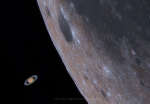
Sometimes Saturn disappears. It doesn't really go away, though, it just disappears from view when our Moon moves in front. Such a Saturnian eclipse was visible along a small swath of Earth -- from Brazil to Sri Lanka -- near the end of last month.
 25 Brightest Stars in the Night Sky
25.06.2019
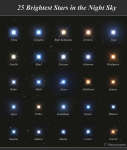
Do you know the names of some of the brightest stars? It's likely that you do, even though some bright stars have names so old they date back to near the beginning of written language.
 Ultraviolet Earth from the Moon
1.07.2000
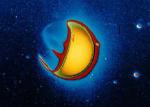
Here's a switch: the above picture is of the Earth taken from a lunar observatory! This false color picture shows how the Earth glows in ultraviolet (UV) light. UV light is so blue humans can't see it.
 Painting with Solar Neutrons
25.10.1995
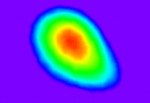
Solar flares are propelled high above the Sun's surface by powerful, twisted magnetic fields. The flares spew high energy atomic and subatomic particles into space. During an intense solar flare on June 15, 1991, a spray of solar neutrons was detected by the COMPTEL instrument onboard NASA's Compton Gamma Ray Observatory.
|
January February March April May June July August September October |
|||||||||||||||||||||||||||||||||||||||||||||||||