
|
You entered: spacecraft
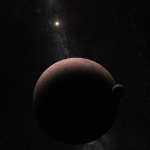 Moon over Makemake
30.04.2016
Makemake, second brightest dwarf planet of the Kuiper belt, has a moon. Nicknamed MK2, Makemake's moon reflects sunlight with a charcoal-dark surface, about 1,300 times fainter than its parent body. Still...
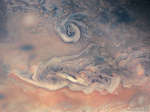 Swirls and Colors on Jupiter from Juno
21.11.2018
What creates the colors in Jupiter's clouds? No one is sure. The thick atmosphere of Jupiter is mostly hydrogen and helium, elements which are colorless at the low temperatures of the Jovian cloud tops.
 Back from Bennu
29.09.2023
Back from asteroid 101955 Bennu, a 110-pound, 31-inch wide sample return capsule rests in a desert on planet Earth in this photo, taken at the Department of Defense Utah Test and Training Range near Salt Lake City last Sunday, September 24.
 APOD: 2024 September 29 Б Seven Dusty Sisters
29.09.2024
Is this really the famous Pleiades star cluster? Known for its iconic blue stars, the Pleiades is shown here in infrared light where the surrounding dust outshines the stars. Here, three infrared colors have been mapped into visual colors (R=24, G=12, B=4.6 microns).
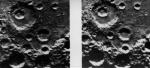 Mercury in Stereo: Craters Within Craters
12.01.1997
This Stereo image pair of craters on on Mercury was produced using data from NASA's robot explorer Mariner 10 which performed three close flybys of the Sun's closest companion, two in 1974 and one in 1975. However, the spacecraft was not equipped with a Stereo camera!
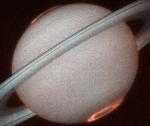 Saturnian Aurora
23.12.2001
the second largest planet in the Solar System, Saturn's Rings are one of the most spectacular sights for earthbound telescopes. This image from the orbiting Hubble Space Telescope's STIS instrument, offers a striking view of another kind of ring around Saturn - pole encircling rings of ultraviolet aurora.
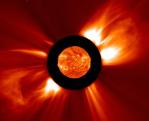 Double Trouble Solar Bubbles
16.05.2002
During April and May, attention has been focused on the western evening sky, presenting its spectacle of bright planets and crescent moons shortly after sunset. Meanwhile, the Sun itself has not been just sinking quietly below the horizon.
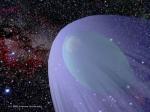 The Suns Heliosphere and Heliopause
24.06.2002
Where does the Sun's influence end? Nobody is sure. Out past the orbits of Neptune and Pluto extends a region named the heliosphere where the Sun's magnetic field and particles from the Solar Wind continue to dominate.
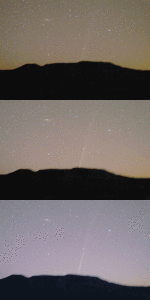 Comet Bradfield Rising
27.04.2004
Comet Bradfield has become quite a sight just before sunrise -- for those with binoculars or cameras. Although fading noticeably each day, a sky chart, a northern location, and some persistence will allow curious sky gazers to locate the cosmic snowball and its spectacular tail.
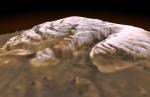 3-D Mars North Pole
16.12.1998
This dramatic premier three-dimensional visualization of Mars' north pole is based on elevation measurements made by an orbiting laser. During the Spring and Summer of 1998 the Mars Orbiter Laser Altimeter (MOLA) flashed laser pulses toward the Martian surface from the Global Surveyor spacecraft and recorded the time it took to detect the reflection.
|
January February March April May June July August September October |
|||||||||||||||||||||||||||||||||||||||||||||||||