
|
You entered: spacecraft
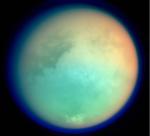 Tantalizing Titan
28.10.2004
Normally hidden by a thick, hazy atmosphere, tantalizing features on Titan's surface appear in this false-color view. The image was recorded as the Cassini spacecraft approached its first close flyby of Saturn's smog-shrouded moon on October 26.
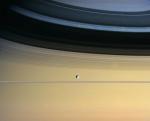 A Year at Saturn
31.12.2005
Arriving at Saturn in July of 2004, the Cassini spacecraft has now spent a year and a half exploring the magnificent rings and moons of the distant gas giant. The year 2005 began with Cassini's Huygens probe landing on Saturn's large moon Titan.
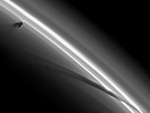 Prometheus Creating Saturn Ring Streamers
27.04.2009
What's causing those strange dark streaks in the rings of Saturn? Prometheus. Specifically, an orbital dance involving Saturn's moon Prometheus keeps creating unusual light and dark streamers in the F-Ring of Saturn. Now Prometheus orbits Saturn just inside the thin F-ring, but ventures into its inner edge about every 15 hours.
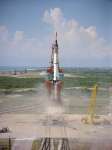 50 Years Ago: Freedom 7 Flies
5.05.2011
Fifty years ago, near the dawn of the space age, NASA controllers "lit the candle" and sent Mercury astronaut Alan Shepard arcing into space atop a Redstone rocket. His cramped space capsule was dubbed Freedom 7.
 APOD: 2024 May 19 Б Jupiter Diving
19.05.2024
Take this simulated plunge and dive into the upper atmosphere of Jupiter, the Solar System's ruling gas giant. The awesome animation is based on image data from JunoCam, and the microwave radiometer on board the Jupiter-orbiting Juno spacecraft.
 The Clouds of Neptune
7.05.1996
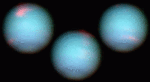
These Hubble Space Telescope (HST) images reveal glimpses of the dynamic atmosphere of Neptune, the Solar System's most distant gas giant planet. The first close-up of Neptune's clouds was provided by NASA's Voyager 2 spacecraft during its August 1989 flyby, giving a tantalizingly brief look.
 Saturn After Equinox
10.11.2009
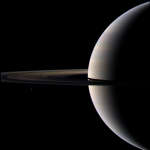
The other side of Saturn's ring plane is now directly illuminated by the Sun. For the previous 15 years, the southern side of Saturn and its rings were directly illuminated, but since Saturn's equinox in August, the orientation has reversed.
 Geostationary Satellites Beyond the Alps
11.04.2012
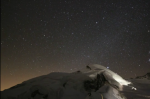
Why don't those stars move? Stars in the sky will typically appear to rise and set as the Earth turns. Those far to the north or south will appear to circle the pole. If you look closely at the above time-lapse movie, however, there are points of light that appear stationary.
 Saturns Moon Dione in Slight Color
5.11.2012
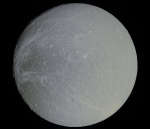
Why does one half of Dione have more craters than the other? Start with the fact that Saturn's moon Dione has one side that always faces Saturn, and one side that always faces away. This is similar to Earth's Moon.
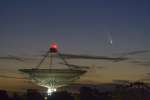 PanSTARRS over Parkes
9.03.2013
Sweeping quickly through southern skies on March 5, Comet PanSTARRS (C/2011 L4) follows the Sun toward the western horizon in this twilight scene. In the foreground is Australia's CSIRO Parkes Radio Telescope, a 64 meter wide steerable dish that is no stranger to the space age exploration of comets.
|
January February March April May June July August September October |
|||||||||||||||||||||||||||||||||||||||||||||||||