
|
You entered: TRACE
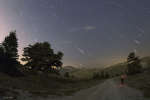 Perseid Meteors over Turkey
1.08.2017
The Perseid Meteor Shower, usually the best meteor shower of the year, will peak late next week. A person watching a clear sky from a dark location might see a bright meteor every minute.
 Retrograde Mars
11.05.2008
Why would Mars appear to move backwards? Most of the time, the apparent motion of Mars in Earth's sky is in one direction, slow but steady in front of the far distant stars. About every two years, however, the Earth passes Mars as they orbit around the Sun.
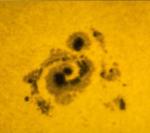 Spiral Sunspot
4.02.1999
Spiral galaxies abound in the universe, but spiral sunspots are definitely an unusual twist. This distinctive spiral-shaped sunspot caught the attention of National Solar Observatory astronomers and was photographed on February 19, 1982 with the Vacuum Solar Telescope on Kitt Peak.
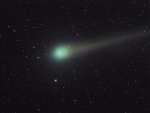 Comet Lulin and Distant Galaxies
7.03.2009
Now fading in our night sky, Comet Lulin has provided some lovely cosmic vistas. Moving rapidly against the background of stars, Lulin briefly posed with the likes of Saturn, and Regulus (Alpha Leo). But here it is seen against a field of distant galaxies.
 Higgs Boson Explained by Cartoon
1.05.2012
What is all this fuss about the Higgs boson? The physics community is abuzz that a fundamental particle expected by the largely successful Standard Model of particle physics may be soon be found by the huge Large Hadron Collider (LHC) at CERN in Europe.
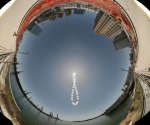 High Noon Analemma Over Azerbaijan
14.10.2013
Is the Sun always straight up at noontime? No. For example, the Sun never appears directly overhead from locations well north or south of the Earth's equator. Conversely, there is always a place on Earth where the Sun will appear at zenith at noon -- for example on the equator during an equinox.
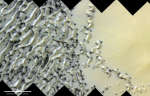 Sand Dunes Thawing on Mars
24.09.2019
What are these strange shapes on Mars? Defrosting sand dunes. As spring dawned on the Northern Hemisphere of Mars, dunes of sand near the pole, as pictured here in late May by ESA's ExoMars Trace Gas Orbiter, began to thaw.
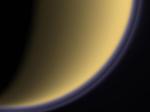 The Double Haze above Titan
10.08.2004
Most moons have no haze layer at all - why does Titan have two? Images from the Cassini spacecraft that slipped into orbit around Saturn last month confirm that the Solar System's most mysterious moon is surrounded not only by a thick atmosphere but also by two distinct spheres of haze.
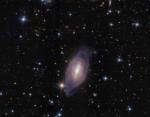 Polar Ring Galaxy NGC 2685
16.02.2007
NGC 2685 is a confirmed polar ring galaxy - a rare type of galaxy with stars, gas and dust orbiting in rings perpendicular to the plane of a flat galactic disk. The bizarre configuration could...
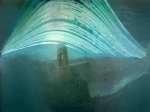 Suspension Bridge Solargraph
15.01.2009
If every picture tells a story, this one might make a novel. The six month long exposure compresses the time from December 17, 2007 to June 21, 2008 into a single point of view.
|
January February March April May June July August September October |
|||||||||||||||||||||||||||||||||||||||||||||||||