
|
You entered: TRACE
 Galactic Cirrus: Mandel Wilson 9
20.07.2023
The combined light of stars along the Milky Way are reflected by these cosmic dust clouds that soar 300 light-years or so above the plane of our galaxy. Known to some as integrated flux nebulae and commonly found at high galactic latitudes, the dusty galactic cirrus clouds are faint.
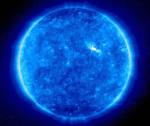 Blue Sun Glaring
5.01.1997
The Sun is a bubbling ball of extremely hot gas. In this false-color picture, light blue regions are extremely hot - over 1 million degrees, while dark blue regions are slightly cooler. The camera filter used was highly sensitive to the emission of highly charged iron ions, which trace the magnetic field of the Sun.
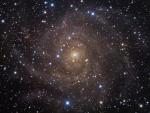 Hidden Galaxy IC 342
5.10.2006
Similar in size to other large, bright spiral galaxies IC 342 is a mere 7 million light-years distant in the long-necked, northern constellation Camelopardalis. A sprawling island universe, IC 342 would otherwise...
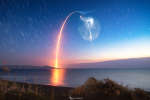 South Celestial Rocket Launch
27.02.2020
At sunset on December 6 a Rocket Lab Electron rocket was launched from a rotating planet. With multiple small satellites on board it departed on a mission to low Earth orbit dubbed Running Out of Fingers from Mahia Peninsula on New Zealand's north island.
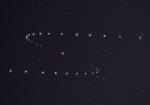 S is for Venus
6.01.2005
Planet Venus traced out this S shape in Earth's sky during 2004. Following the second planet from the Sun in a series of 29 images recorded from April 3rd through August...
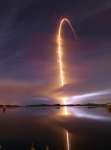 RBSP Night Launch
2.09.2012
This graceful arc traces a Delta rocket climbing through Thursday's early morning skies over Cape Canaveral Air Force Station in Florida, USA. Snug inside the rocket's Centaur upper stage were NASA's twin Radiation Belt Storm Probes (RBSP), now in separate orbits within planet Earth's Van Allen radiation belts.
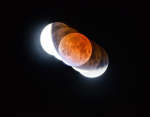 At the Shadow s Edge
24.11.2021
Shaped like a cone tapering into space, the Earth's dark central shadow or umbra has a circular cross-section. It's wider than the Moon at the distance of the Moon's orbit though. But during the lunar eclipse of November 18/19, part of the Moon remained just outside the umbral shadow.
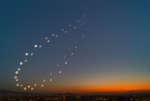 A Double Lunar Analemma over Turkey
9.10.2022
An analemma is that figure-8 curve you get when you mark the position of the Sun at the same time each day for one year. But the trick to imaging an analemma of the Moon is to wait bit longer.
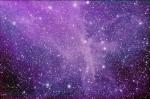 An Unexplored Nebula
29.09.2005
The combined light of the stars of the Milky Way are reflected by this cosmic dust cloud that soars some 300 light-years above the plane of our Galaxy. Dubbed the Angel Nebula by astronomer...
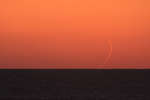 Moonset from Taiwan
14.08.2013
It took three worlds to create this simple image. The first world was the Earth, which was quite prominent. The dividing line running horizontally below the middle separates sea from sky. On this part of the Earth, it was almost nighttime. The second world was the Moon, which was almost invisible.
|
January February March April May June July August September October |
|||||||||||||||||||||||||||||||||||||||||||||||||