
|
You entered: planet
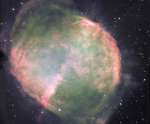 M27: Not A Comet
26.06.2008
Born on June 26th in 1730, astronomer Charles Messier scanned 18th century French skies for comets. To avoid confusion and aid his comet hunting, he diligently recorded this object as number 27 on his list of things which are definitely not comets.
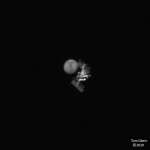 ISS Transits Mars
22.09.2020
Yes, but have you ever seen the space station do this? If you know when and where to look, watching the bright International Space Station (ISS) drift across your night sky is a fascinating sight -- but not very unusual.
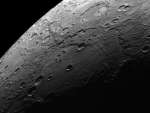 Rembrandt Impact Basin on Mercury
4.05.2009
Why do portions of this huge crater on Mercury have so much iron? The unusual Rembrandt impact basin was discovered recently in images taken during the robotic MESSENGER spacecraft's 2008 October flyby of the Solar System's innermost planet.
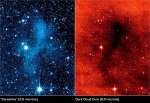 Coreshine from a Dark Cloud
30.09.2010
Stars and their planets are born in cold, dark, interstellar clouds of gas and dust. While exploring the clouds at infrared wavelengths, astronomers have made a surprising discovery -- dozens of cases where dense cloud cores shine by reflecting infrared starlight.
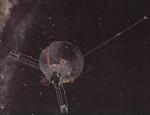 Pioneer 10: The First 7 Billion Miles
25.08.2001
Q: What was made by humans and is 7.3 billion miles away? A: Pioneer 10 -- and 1997 was the 25th anniversary of its launch. Almost 11 light-hours distant, Pioneer 10 is presently about twice as far from the Sun as Pluto, and bound for interstellar space at 28,000 miles per hour.
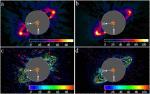 HR 4796A: Not Saturn
4.02.1999
These are not false-color renderings of the latest observations of Saturn's magnificent rings. Instead, the panels show a strikingly similar system on a much larger scale - a ring around the young, Vega-like star, HR 4796A, located about 200 light-years from Earth.
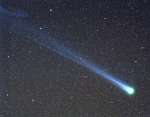 Comet Hyakutake Passes the Earth
15.12.2009
In 1996, an unexpectedly bright comet passed by planet Earth. Discovered less than two months before, Comet C/1996 B2 Hyakutake came within only 1/10th of the Earth-Sun distance from the Earth in late March.
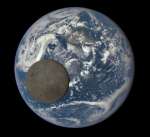 Full Earth, Full Moon
6.08.2015
The Moon was new on July 16. Its familiar nearside facing the surface of planet Earth was in shadow. But on that date a million miles away, the Deep Space Climate Observatory (DSCOVR) spacecraft's Earth Polychromatic Imaging Camera (EPIC) captured this view of an apparently Full Moon crossing in front of a Full Earth.
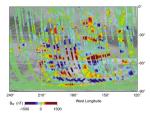 Magnetic Mars
4.05.1999
Mapping Mars from orbit, instruments on the Mars Global Surveyor (MGS) spacecraft have recently revealed banded magnetic field patterns - a startling and unanticipated suggestion that the Red Planet was more Earth-like in its distant past.
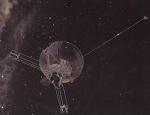 Pioneer 10: The First 6 Billion Miles
20.06.1998
Q: What was made by humans and is 6.5 billion miles away? A: Pioneer 10 - and last year was the 25th anniversary of its launch. More than 9.5 light-hours distant, Pioneer 10 is presently about twice as far from the Sun as Pluto, bound for interstellar space at 28,000 miles per hour.
|
January February March April May June July August September October |
|||||||||||||||||||||||||||||||||||||||||||||||||