
|
You entered: planet
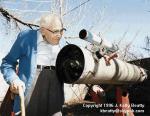 Clyde W. Tombaugh: 1906-1997
3.02.1997
Astronomer Clyde Tombaugh, discoverer of Pluto, died on January 17th. Inspiring many during his long and exceptional career, he had been living in Las Cruces, New Mexico with his wife of 60 years, Patsy. Today would have been his 91st birthday.
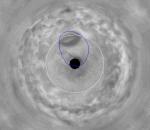 Jupiter's Great Dark Spot
18.03.2003
Seventeenth century astronomer Giovanni Domenico Cassini was an astute observer of Jupiter's Great Red Spot. So it seems only fitting that his namesake, the Cassini spacecraft, has enabled detailed observations of another planet-sized blemish -- Jupiter's Great Dark Spot.
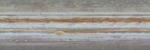 Jupiter Unpeeled
14.02.2001
Slice Jupiter from pole to pole, peel back its outer layers of clouds, stretch them onto a flat surface ... and for all your trouble you'd end up with something that looks a lot like this. Scrolling right will reveal the full picture, a color mosaic of Jupiter from the Cassini spacecraft.
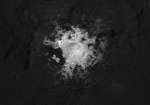 Cerealia Facula
18.07.2018
Cerealia Facula, also known as the brightest spot on Ceres, is shown in this stunning mosaic close-up view. The high-resolution image data was recorded by the Dawn spacecraft, in a looping orbit, from altitudes as low as 34 kilometers (21 miles) above the dwarf planet's surface.
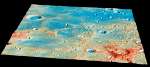 MESSENGER s Last Day on Mercury
30.04.2015
The first to orbit Mercury, the MESSENGER spacecraft came to rest on this region of Mercury's surface yesterday. Constructed from MESSENGER image and laser altimeter data, the scene looks north over the northeastern rim of the broad, lava filled Shakespeare basin.
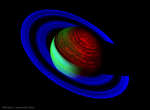 Neon Saturn
12.03.2016
If seen in the right light, Saturn glows like a neon sign. Although Saturn has comparatively little of the element neon, a composite image false-colored in three bands of infrared light highlights features of the giant ringed planet like a glowing sign.
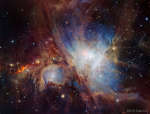 The Orion Nebula in Infrared from HAWK I
17.07.2016
The deepest infrared image of the Orion Nebula has uncovered a bonanza of previously unknown low-mass stars and -- quite possibly -- free floating planets. The picturesque nebula is best known in visible light where it shows a many bright stars and bright glowing gas.
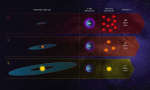 Goldilocks Zones and Stars
30.01.2020
The Goldilocks zone is the habitable zone around a star where it's not too hot and not too cold for liquid water to exist on the surface of orbiting planets. This intriguing infographic...
 A Double Ringed Basin on Mercury
7.10.2009
What created the internal second ring of this double ringed basin on Mercury? No one is sure. The unusual feature spans 160 kilometers and was imaged during the robotic MESSENGER spacecraft's swing past our Solar System's innermost planet last week.
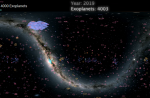 4000 Exoplanets
13.08.2022
Over 4000 planets are now known to exist outside our Solar System. Known as exoplanets, this milestone was passed last month, as recorded by NASA's Exoplanet Archive. The featured video highlights these exoplanets in sound and light, starting chronologically from the first confirmed detection in 1992 and continuing into 2019.
|
January February March April May June July August September October |
|||||||||||||||||||||||||||||||||||||||||||||||||