
|
You entered: planet
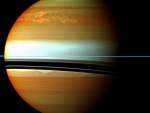 A Raging Storm System on Saturn
28.04.2013
It was one of the largest and longest lived storms ever recorded in our Solar System. First seen in late 2010, the above cloud formation in the northern hemisphere of Saturn started larger than the Earth and soon spread completely around the planet.
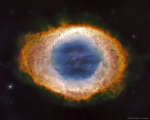 M57: The Ring Nebula
17.04.2018
Except for the rings of Saturn, the Ring Nebula (M57) is probably the most famous celestial band. Its classic appearance is understood to be due to our own perspective, though. The recent mapping...
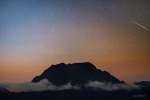 Comet Halley vs Comet SWAN
14.05.2020
The pre-dawn hours of May 3rd were moonless as grains of cosmic dust streaked through southern skies above Reunion Island. Swept up as planet Earth plowed through dusty debris streams left behind periodic Comet 1/P Halley, the annual meteor shower is known as the Eta Aquarids.
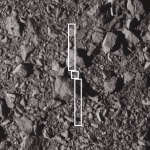 DART vs Dimorphos
9.03.2023
On the first planetary defense test mission from planet Earth, the DART spacecraft captured this close-up on 26 September 2022, three seconds before slamming into the surface of asteroid moonlet Dimorphos. The spacecraft's outline with two long solar panels is traced at its projected point of impact between two boulders.
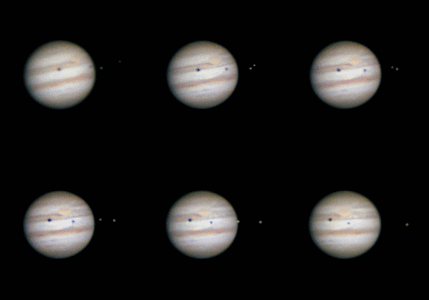 When Moons and Shadows Dance
27.02.2003
It's no wonder Jupiter is a favorite target for even modest earthbound telescopes. The most massive planet in the solar system with four of the largest moons also boasts the famous Great Red Spot, a giant hurricane-like storm system over three hundred years old.
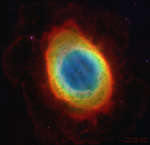 M57: The Ring Nebula from Hubble
17.08.2021
Except for the rings of Saturn, the Ring Nebula (M57) is probably the most famous celestial circle. Its classic appearance is understood to be due to our own perspective, though. The recent mapping...
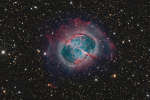 M27: Not a Comet
29.08.2019
While hunting for comets in the skies above 18th century France, astronomer Charles Messier diligently kept a list of the things he encountered that were definitely not comets. This is number 27 on his now famous not-a-comet list.
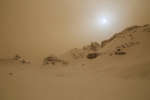 Swiss Alps, Martian Sky
18.02.2021
Taken on February 6, this snowy mountain and skyscape was captured near Melchsee-Frutt, central Switzerland, planet Earth. The reddish daylight and blue tinted glow around the afternoon Sun are colors of the Martian sky, though. Of course both worlds have the same Sun.
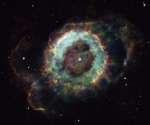 NGC 6369: The Little Ghost Nebula
14.01.2012
This pretty planetary nebula, cataloged as NGC 6369, was discovered by 18th century astronomer William Herschel as he used a telescope to explore the medicinal constellation Ophiucus. Round and planet-shaped, the nebula is also relatively faint and has acquired the popular moniker of Little Ghost Nebula.
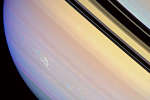 A Persistent Electrical Storm on Saturn
5.05.2008
How do large storms evolve on Saturn? On Earth, a hurricane can persist for weeks, while the Great Red Spot on Jupiter has been in existence for over 150 years. On Saturn, a storm system has now set a new endurance record, now being discernable for greater than three months.
|
January February March April May June July August September October |
|||||||||||||||||||||||||||||||||||||||||||||||||