
|
You entered: constellation
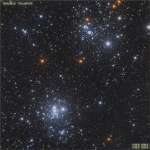 A Double Star Cluster
1.01.2013
Few star clusters are seen to be so close to each other. Some 7,000 light-years away, though, this pair of open or galactic star clusters is an easy binocular target, a lovely starfield in the northern constellation Perseus.
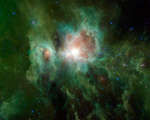 Infrared Orion from WISE
13.02.2013
The Great Nebula in Orion is a intriguing place. Visible to the unaided eye, it appears as a small fuzzy patch in the constellation of Orion. But this image, an illusory-color composite of four...
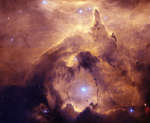 A Massive Star in NGC 6357
22.10.2013
For reasons unknown, NGC 6357 is forming some of the most massive stars ever discovered. One such massive star, near the center of NGC 6357, is framed above carving out its own interstellar castle with its energetic light from surrounding gas and dust.
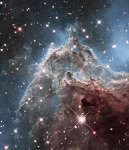 At the Edge of NGC 2174
3.04.2014
This fantastic skyscape lies near the edge of NGC 2174 a star forming region about 6,400 light-years away in the nebula-rich constellation of Orion. It follows mountainous clouds of gas and dust carved...
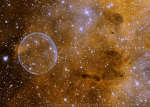 The Soap Bubble Nebula
12.01.2015
Adrift in the rich star fields of the constellation Cygnus, this lovely, symmetric nebula was only recognized a few years ago and does not yet appear in some astronomical catalogs. In fact, amateur astronomer...
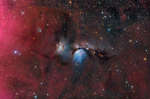 M78 Wide Field
29.12.2017
Interstellar dust clouds and glowing nebulae abound in the fertile constellation of Orion. One of the brightest, M78, is centered in this colorful, wide field view, covering an area north of Orion's belt. At a distance of about 1,500 light-years, the bluish reflection nebula is around 5 light-years across.
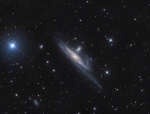 Galaxies in the River
10.05.2018
Large galaxies grow by eating small ones. Even our own galaxy practices galactic cannibalism, absorbing small galaxies that get too close and are captured by the Milky Way's gravity. In fact, the practice...
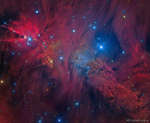 In the Vicinity of the Cone Nebula
16.04.2019
Strange shapes and textures can be found in neighborhood of the Cone Nebula. The unusual shapes originate from fine interstellar dust reacting in complex ways with the energetic light and hot gas being expelled by the young stars.
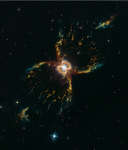 The Shape of the Southern Crab
24.04.2019
The symmetric, multi-legged appearance of the Southern Crab Nebula is certainly distinctive. About 7,000 light-years distant toward the southern sky constellation Centaurus, its glowing nested hourglass shapes are produced by the remarkable symbiotic binary star system at its center.
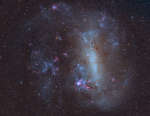 The Large Cloud of Magellan
5.09.2019
The 16th century Portuguese navigator Ferdinand Magellan and his crew had plenty of time to study the southern sky during the first circumnavigation of planet Earth. As a result, two fuzzy cloud-like objects easily...
|
January February March April May June July August September October |
|||||||||||||||||||||||||||||||||||||||||||||||||