
|
You entered: constellation
 APOD: 2026 May 16 Б Aurora Slathers Up the Sky
15.05.2026
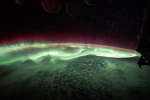
Like salsa verde on your favorite burrito, a green aurora slathers up the sky in this 2017 June 25 snapshot from the International Space Station. About 400 kilometers (250 miles) above Earth, the orbiting station is itself within the upper realm of the auroral displays.
 M55: Globular Star Cluster
22.09.2000
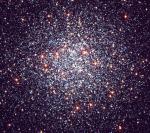
The fifty-fifth entry in Charles Messier's catalog, M55 is a large and lovely globular cluster of around 100,000 stars. Only 20,000 light-years away in the constellation Sagittarius, M55 appears to earth-bound observers to be nearly 2/3 the size of the full moon.
 Henize 3 401: An Elongated Planetary Nebula
31.07.2002
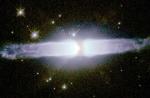
How do dying stars eject their outer layers? Stars that create elegant planetary nebulas like Henize 3-401, pictured above, are not unusual, causing speculation that, one day, our own Sun may look like this.
 Cosmic Construction Zone RCW 49
3.06.2004
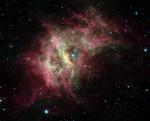
Stars and planets appear to be under construction in dusty nebula RCW 49. This Spitzer Space Telescope false-color infrared view of the nearby stellar nursery shows that known, hot stars are well on their way to clearing out the nebula's central regions.
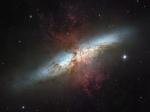 M82: Galaxy with a Supergalactic Wind
25.04.2006
What's lighting up the Cigar Galaxy? M82, as this irregular galaxy is also known, was stirred up by a recent pass near large spiral galaxy M81. This doesn't fully explain the source of the red-glowing outwardly expanding gas, however.
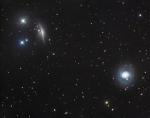 NGC 1055 and M77
14.12.2006
Large spiral galaxy NGC 1055 (top left) joins spiral M77 in this lovely cosmic view toward the constellation Cetus. The narrowed, dusty appearance of edge-on spiral NGC 1055 contrasts nicely with the face-on view of M77's bright nucleus and spiral arms.
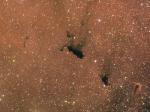 Molecular Cloud Barnard 163
20.03.2007
It may look to some like a duck, but it lays stars instead of eggs. In the center of the above image lies Barnard 163, a nebula of molecular gas and dust so thick that visible light can't shine through it.
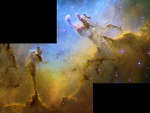 The Eagle Nebula in Hydrogen Oxygen, and Silicon
26.02.2008
Bright blue stars are still forming in the dark pillars of the Eagle Nebula. Made famous by a picture from the Hubble Space Telescope in 1995, the Eagle Nebula shows the dramatic process of star formation.
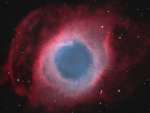 Spokes in the Helix Nebula
4.09.2008
At first glance, the Helix Nebula (aka NGC 7293), looks simple and round. But this well-studied example of a planetary nebula, produced near the end of the life of a sun-like star, is now understood to have a surprisingly complex geometry. Its extended loops and comet-shaped features have been explored in Hubble Space Telescope images.
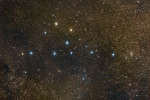 Collinder 399: The Coat Hanger
22.12.2008
Is this coat hanger a star cluster or an asterism? This cosmic hang-up has been debated over much of last century, as astronomers wondered whether this binocular-visible object is really a physically associated open cluster or a chance projection. Chance star projections are known as asterisms, an example of which is the popular Big Dipper.
|
January February March April May June July August September October |
|||||||||||||||||||||||||||||||||||||||||||||||||