
|
You entered: galaxies
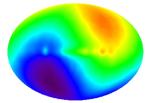 CMBR Dipole: Speeding Through the Universe
8.05.2005
Our Earth is not at rest. The Earth moves around the Sun. The Sun orbits the center of the Milky Way Galaxy. The Milky Way Galaxy orbits in the Local Group of Galaxies. The Local Group falls toward the Virgo Cluster of Galaxies.
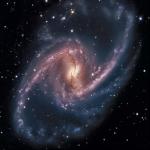 NGC 1365: Majestic Island Universe
28.03.2007
Barred spiral galaxy NGC 1365 is truly a majestic island universe some 200,000 light-years across. Located a mere 60 million light-years away toward the chemical constellation Fornax, NGC 1365 is a dominant member of the well-studied Fornax galaxy cluster.
 NGC 206 and the Star Clouds of Andromeda
12.04.2023
The large stellar association cataloged as NGC 206 is nestled within the dusty arms of the neighboring Andromeda galaxy along with the galaxy's pinkish star-forming regions. Also known as M31, the spiral galaxy is a mere 2.5 million light-years away.
 APOD: 2023 November 13 Б Andromeda over the Alps
13.11.2023
Have you ever seen the Andromeda galaxy? Although M31 appears as a faint and fuzzy blob to the unaided eye, the light you see will be over two million years old, making it likely the oldest light you ever will see directly.
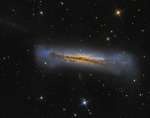 Edge on NGC 3628
4.11.2011
Sharp telescopic views of magnificent edge-on spiral galaxy NGC 3628 show a puffy galactic disk divided by dark dust lanes. The tantalizing scene puts many astronomers in mind of its popular moniker, The Hamburger Galaxy.
 Arp 93: A Cosmic Embrace
16.08.2023
Locked in a cosmic embrace, two large galaxies are merging at the center of this sharp telescopic field of view. The interacting system cataloged as Arp 93 is some 200 million light-years distant toward the constellation Aquarius in planet Earth's sky. Individually the galaxies are identified as NGC 7285 (right) and NGC 7284.
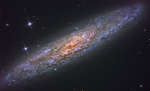 NGC 253: Dusty Island Universe
21.11.2009
Shiny NGC 253 Galaxy, is one of the brightest spiral galaxies visible, and also one of the dustiest. Some call it the Silver Dollar Galaxy for its appearance in small telescopes, or just the Sculptor Galaxy for its location within the boundaries of the southern constellation Sculptor.
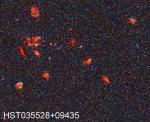 A Cluster Too Far
8.09.1998
Why is this galaxy cluster so red? Nearby clusters have galaxies with colors that are much more yellow and blue. A leading explanation is that this cluster of galaxies lies so far across our universe (z~1) that cosmological time dilation significantly reddens the light.
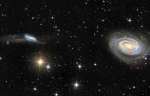 Arp 159 and NGC 4725
3.09.2015
Pointy stars and peculiar galaxies span this cosmic snapshot, a telescopic view toward the well-groomed constellation Coma Berenices. Bright enough to show off diffraction spikes, the stars are in the foreground of the scene, well within our own Milky Way. But the two prominent galaxies lie far beyond our own, some 41 million light-years distant.
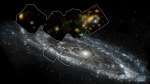 High Energy Andromeda
7.01.2016
A mere 2.5 million light-years away, the Andromeda Galaxy, also known as M31, really is just next door as large galaxies go. In this (inset) scan, image data from NASA's Nuclear Spectrosopic Telescope...
|
January February March April May June July August September October |
|||||||||||||||||||||||||||||||||||||||||||||||||