
|
You entered: galaxies
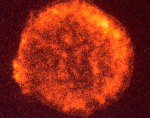 Tychos Supernova Remnant in X ray
7.03.1999
How often do stars explode? By looking at external galaxies, astronomers can guess that these events, known as a supernovae, should occur about once every 30 years in a typical spiral galaxy like our MilkyWay.
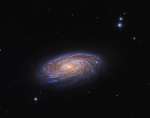 Messier 88
30.01.2010
Charles Messier described the 88th entry in his 18th century catalog of Nebulae and Star Clusters as a spiral nebula without stars. Of course the gorgeous M88 is now understood to be a galaxy full of stars, gas, and dust, not unlike our own Milky Way.
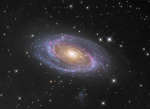 Messier 81
12.03.2021
One of the brightest galaxies in planet Earth's sky is similar in size to our Milky Way Galaxy: big, beautiful Messier 81. Also known as NGC 3031 or Bode's galaxy for its 18th century discoverer, this grand spiral can be found toward the northern constellation of Ursa Major, the Great Bear.
 Voorwerpjes in Space
4.04.2015
Mysterious Hanny's Voorwerp, Dutch for "Hanny's Object", is really enormous, about the size of the Milky Way Galaxy and glowing strongly in the greenish light produced by ionized oxygen atoms.
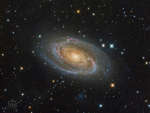 Messier 81
17.04.2019
One of the brightest galaxies in planet Earth's sky is similar in size to our Milky Way Galaxy: big, beautiful Messier 81. Also known as NGC 3031 or Bode's galaxy for its 18th century discoverer, this grand spiral can be found toward the northern constellation of Ursa Major, the Great Bear.
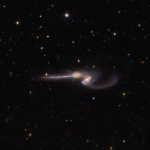 NGC 4676: The Mighty Mice
14.06.2019
These two mighty galaxies are pulling each other apart. Known as The Mice because they have such long tails, each large spiral galaxy has actually passed through the other. Their long tails are drawn out by strong gravitational tides rather than collisions of their individual stars.
 A Slice Through an Artificial Universe
23.06.1998
We live in the era of humanity when most of our Universe is being mapped. To help understand these maps, astronomers computationally estimate the appearance of several possible candidate universes, to which maps of the real Universe can be compared.
 APOD: 2023 July 5 Б A Map of the Observable Universe
5.07.2023
What if you could see out to the edge of the observable universe? You would see galaxies, galaxies, galaxies, and then, well, quasars, which are the bright centers of distant galaxies. To expand understanding...
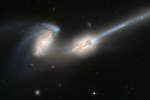 NGC 4676: When Mice Collide
24.02.2008
These two mighty galaxies are pulling each other apart. Known as " The Mice" because they have such long tails, each spiral galaxy has likely already passed through the other. They will probably collide again and again until they coalesce.
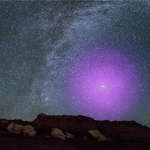 A Halo for Andromeda
3.09.2020
M31, the Andromeda Galaxy, is the closest large spiral galaxy to our Milky Way. Some 2.5 million light-years distant it shines in Earth's night sky as a small, faint, elongated cloud just visible to the unaided eye.
|
January February March April May June July August September October |
|||||||||||||||||||||||||||||||||||||||||||||||||