
|
You entered: galaxies
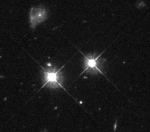 A Milestone Quasar
18.08.1996
Here is a rather typical quasar. But since quasars are so unusual it is quite atypical of most familiar objects. Of the two bright objects in the center of this photo, the quasar is on the left.
 Hickson 44 in Leo
3.04.2025
Scanning the skies for galaxies, Canadian astronomer Paul Hickson and colleagues identified some 100 compact groups of galaxies, now appropriately called Hickson Compact Groups. The four prominent galaxies seen in this intriguing telescopic skyscape are one such group, Hickson 44.
 NGC 1365: Majestic Island Universe
11.10.2017
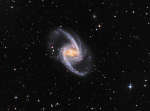
Barred spiral galaxy NGC 1365 is truly a majestic island universe some 200,000 light-years across. Located a mere 60 million light-years away toward the chemical constellation Fornax, NGC 1365 is a dominant member of the well-studied Fornax galaxy cluster.
 Messier 61 Close Up
27.08.2019
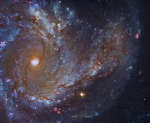
Image data from the Hubble Space Telescope, the European Southern Observatory, and small telescopes on planet Earth are combined in this magnificent portrait of face-on spiral galaxy Messier 61 (M61). A mere 55 million light-years away in the Virgo Cluster of Galaxies, M61 is also known as NGC 4303.
 NGC 1365: Majestic Island Universe
7.01.2021
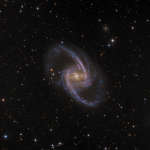
Barred spiral galaxy NGC 1365 is truly a majestic island universe some 200,000 light-years across. Located a mere 60 million light-years away toward the chemical constellation Fornax, NGC 1365 is a dominant member of the well-studied Fornax Cluster of galaxies.
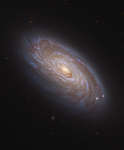 Messier 88
27.12.2022
Charles Messier described the 88th entry in his 18th century catalog of Nebulae and Star Clusters as a spiral nebula without stars. Of course the gorgeous M88 is now understood to be a galaxy full of stars, gas, and dust, not unlike our own Milky Way.
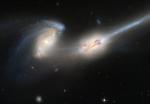 NGC 4676: When Mice Collide
12.06.2004
These two mighty galaxies are pulling each other apart. Known as "The Mice" because they have such long tails, each spiral galaxy has likely already passed through the other. They will probably collide again and again until they coalesce.
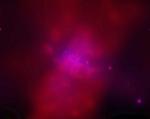 M82: Starburst in X-rays
21.04.2000
Star formation occurs at a faster pace in M82 -- a galaxy with about 10 times the rate of massive star birth (and death) compared to our Milky Way. Winds from massive stars and blasts...
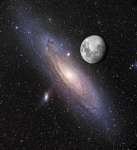 Moon Over Andromeda
1.08.2013
The Great Spiral Galaxy in Andromeda (aka M31), a mere 2.5 million light-years distant, is the closest large spiral to our own Milky Way. Andromeda is visible to the unaided eye as a small...
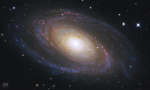 Messier 81
26.03.2025
One of the brightest galaxies in planet Earth's sky is similar in size to our Milky Way Galaxy: big, beautiful Messier 81. Also known as NGC 3031 or Bode's galaxy for its 18th century discoverer, this grand spiral can be found toward the northern constellation of Ursa Major, the Great Bear.
|
January February March April May June July August September October |
|||||||||||||||||||||||||||||||||||||||||||||||||