
|
You entered: NASA
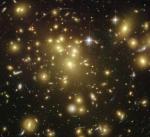 Abell 1689 Warps Space
9.01.2003
Two billion light-years away, galaxy cluster Abell 1689 is one of the most massive objects in the Universe. In this view from the Hubble Space Telescope's Advanced Camera for Surveys, Abell...
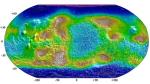 Neutron Mars
4.09.2004
Looking for water on Mars, researchers using detectors on board the orbiting Mars Odyssey spacecraft have created this false-color global map of energetic neutrons from the otherwise Red Planet. What do neutrons have to do with water?
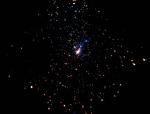 X Ray Stars in the Orion Nebula
19.05.2005
When our middle-aged Sun was just a few million years old it was thousands of times brighter in x-rays. In fact, it was likely similar to some of the stars found in this false-color x-ray composite of the Orion Nebula region from the Chandra Observatory.
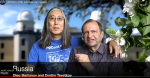 APOD is 25 Years Old Today
16.06.2020
Welcome to the quadranscentennial year of the Astronomy Picture of the Day. Perhaps a source of consistency for some, APOD is still here. To help celebrate APOD's Silver Anniversary, some of APOD's TVAoTaSMD have recorded a birthday greeting and thanks to APOD's readership in today's featured video.
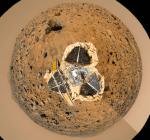 Slightly Above Mars Pathfinder
12.09.2000
If you could have hovered above the Pathfinder mission to Mars in 1997, this is what you might have seen. Directly below you is the control tower of Sagan Memorial Station. Three dark solar...
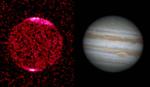 Jupiter s Great X Ray Spot
1.03.2002
The Solar System's largest planet, gas giant Jupiter, is famous for its swirling Great Red Spot. In the right hand panel above, the familiar giant planet with storm system and cloud bands is shown in an optical image from the passing Cassini spacecraft.
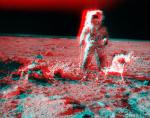 Apollo 12: Stereo View Near Surveyor Crater
13.07.2002
This weekend's stereo picture finds Apollo 12 astronaut Pete Conrad standing on the lunar surface near the southern rim of Surveyor Crater in November of 1969. With red/blue glasses you can gaze beyond the spacesuited Conrad across the magnificent desolation of the Moon's Ocean of Storms.
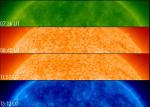 Mercury Spotting
8.05.2003
Can you spot the planet? The diminutive disk of Mercury, the solar system's innermost planet, spent about five hours crossing in front of the enormous solar disk yesterday (Wednesday, May 7th), as viewed from the general vicinity of planet Earth.
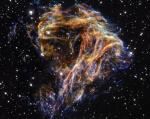 N49's Cosmic Blast
6.03.2004
Scattered debris from a cosmic supernova explosion lights up the sky in this gorgeous composited image based on data from the Hubble Space Telescope. Cataloged as N49, these glowing filaments of shocked gas span about 30 light-years in our neighboring galaxy, the Large Magellanic Cloud.
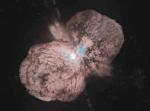 Doomed Star Eta Carinae
28.11.2004
Eta Carinae may be about to explode. But no one knows when - it may be next year, it may be one million years from now. Eta Carinae's mass - about 100 times greater than our Sun - makes it an excellent candidate for a full blown supernova.
|
January February March April May June July August September October |
|||||||||||||||||||||||||||||||||||||||||||||||||