
|
You entered: NASA
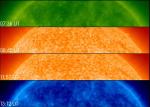 Mercury Spotting
6.06.2004
Can you spot the planet? The diminutive disk of Mercury, the solar system's innermost planet, spent about five hours crossing in front of the enormous solar disk on 2003 May 7, as viewed from the general vicinity of planet Earth.
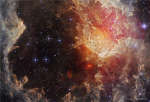 NGC 7822: Stars and Dust Pillars in Infrared
18.11.2017
Young stars themselves are clearing out their nursery in NGC 7822. Within the nebula, bright edges and complex dust sculptures dominate this detailed skyscape taken in infrared light by NASA's Wide Field Infrared Survey Explorer (WISE) satellite.
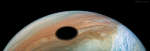 Io Eclipse Shadow on Jupiter from Juno
6.10.2019
What's that dark spot on Jupiter? It's the shadow of Jupiter's most volcanic moon Io. Since Jupiter shines predominantly by reflected sunlight, anything that blocks that light leaves a shadow. If you could somehow be in that shadow, you would see a total eclipse of the Sun by Io.
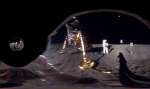 Unwrapped: Five Decade Old Lunar Selfie
26.09.2021
Here is one of the most famous pictures from the Moon -- but digitally reversed. Apollo 11 landed on the moon in 1969 and soon thereafter many pictures were taken, including an iconic picture of Buzz Aldrin taken by Neil Armstrong.
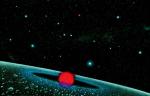 Water Found Around Nearby Star CW Leonis
16.07.2001
Do worlds outside our Solar System have oceans of water like Earth? An indication that such worlds might exist was bolstered recently by new evidence that nearby star system CW Leonis harbors water. Recent observations with the Submillimeter Wave Astronomy Satellite (SWAS) found significant detections of light at specific colors emitted by water.
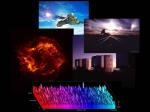 A Year of New Perspectives
27.12.1999
Fittingly, 1999 saw a decade of astronomical discoveries to an end with portents of things to come - embodied in new spacecraft, telescopes, and perspectives to explore the distant Universe across the electromagnetic spectrum. X-ray astronomy in particular will likely flourish in coming
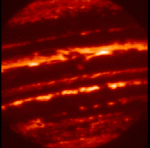 Beneath Jupiter's Clouds
22.01.1996
This near-infrared image of Jupiter was made using instrumentation at NASA's Infrared Telescope Facility, located on the summit of Mauna Kea, Hawaii, in support of the Galileo mission to Jupiter. The brightest spots...
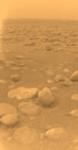 Titan Landscape
16.01.2005
This color view from Titan gazes across a suddenly familiar but distant landscape on Saturn's largest moon. The scene was recorded by ESA's Huygens probe after a 2 1/2 hour descent through a thick atmosphere of nitrogen laced with methane.
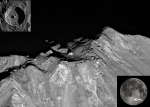 The Unusual Boulder at Tychos Peak
6.05.2018
Why is there a large boulder near the center of Tycho's peak? Tycho crater on the Moon is one of the easiest features to see, visible even to the unaided eye (inset, lower right). But at the center of Tycho (inset, upper left) is a something unusual -- a 120-meter boulder.
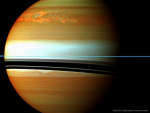 APOD: 2025 October 5 Б A Long Storm System on Saturn
4.10.2025
It was one of the largest and longest lived storms ever recorded in our Solar System. First seen in late 2010, the featured cloud formation in the northern hemisphere of Saturn started larger than the Earth and soon spread completely around the planet.
|
January February March April May June July August September October |
|||||||||||||||||||||||||||||||||||||||||||||||||