
|
You entered: NASA
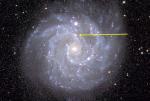 A Gamma Ray Burst Supernova Connection
14.04.2003
New evidence has emerged that a mysterious type of explosion known as a gamma ray burst is indeed connected to a supernova of the type visible in the above image. Two weeks ago, the orbiting HETE satellite detected gamma-ray burst GRB030329.
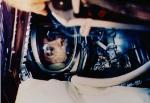 Alan B. Shepard Jr. 1923 1998
24.07.1998
On another Friday (May 5, 1961), at the dawn of the space age, NASA controllers "lit the candle" and sent Alan B. Shepard Jr. arcing into space atop a Redstone rocket. The picture shows...
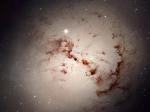 NGC 1316: After Galaxies Collide
4.04.2005
How did this strange-looking galaxy form? Astronomers turn detectives when trying to figure out the cause of unusual jumbles of stars, gas, and dust like NGC 1316. A preliminary inspection indicates that NGC 1316 is an enormous elliptical galaxy that includes dark dust lanes usually found in a spiral.
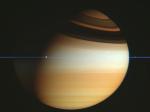 Cassini Spacecraft Crosses Saturns Ring Plane
4.05.2005
If this is Saturn, where are the rings? When Saturn's "appendages" disappeared in 1612, Galileo did not understand why. Later that century, it became understood that Saturn's unusual protrusions were rings and that when the Earth crosses the ring plane, the edge-on rings will appear to disappear.
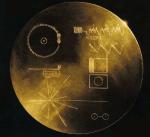 The Voyagers Message in a Bottle
8.09.2007
Launched thirty years ago, NASA's Voyager 1 and 2 spacecraft are now respectively 15 billion and 12.5 billion kilometers from the Sun, equivalent to about 14 and 11.5 light-hours distant. Still functioning, the Voyagers are being tracked and commanded through the Deep Space Network.
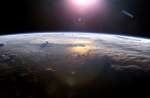 Yuri s Planet
12.04.2008
On April 12th, 1961, Soviet cosmonaut Yuri Alexseyevich Gagarin became the first human in space. His remotely controlled Vostok 1 spacecraft lofted him to an altitude of 200 miles and carried him once around planet Earth. Commenting on the first view from space he reported, "The sky is very dark; the Earth is bluish.
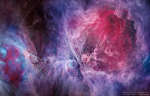 The Orion Nebula in Visible and Infrared
17.05.2016
The Great Nebula in Orion is a colorful place. Visible to the unaided eye, it appears as a small fuzzy patch in the constellation of Orion. Long exposure, multi-wavelength images like this, however, show the Orion Nebula to be a busy neighborhood of young stars, hot gas, and dark dust.
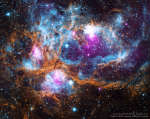 NGC 6357: Stellar Wonderland
26.12.2016
For reasons unknown, NGC 6357 is forming some of the most massive stars ever discovered. This complex wonderland of star formation consists of numerous filaments of dust and gas surrounding huge cavities of massive star clusters. The intricate patterns are caused by complex interactions between interstellar winds, radiation pressures, magnetic fields, and gravity.
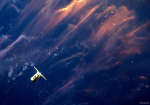 Approach above Sunset
2.05.2017
There it is! The Cygnus supply ship was a welcome sight to the astronauts on the International Space Station just over a week ago. Launched three days before on a United Launch Alliance Atlas...
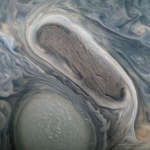 Giant Storms and High Clouds on Jupiter
29.12.2021
What and where are these large ovals? They are rotating storm clouds on Jupiter imaged last month by NASA's Juno spacecraft. In general, higher clouds are lighter in color, and the lightest clouds visible are the relatively small clouds that dot the lower oval.
|
January February March April May June July August September October |
|||||||||||||||||||||||||||||||||||||||||||||||||